Showing posts with label poetry. Show all posts

Saturday, January 01, 2011

Another year is dawning

Another year is dawning;
Dear Father, let it be
In working or in waiting,
Another year with Thee;
Another year of progress,
Another year of praise,
Another year of proving
Thy presence all the days.

Another year of mercies,
Of faithfulness and grace,
Another year of gladness
In the shining of Thy face;
Another year of leaning
Upon Thy loving breast;
Another year of trusting,
Of quiet, happy rest.

Another year of service,
Of witness for Thy love,
Another year of training
For holier work above.
Another year is dawning:
Dear Father, let it be
On earth, or else in heaven,
Another year for Thee.

Saturday, December 25, 2010

Mary's Song

by Luci Shaw

Blue homespun and the bend of my breast
keep warm this small hot naked star
fallen to my arms. (Rest ...
you who have had so far
to come.) Now nearness satisfies
the body of God sweetly. Quiet he lies
whose vigour hurled
a universe. He sleeps
whose eyelids have not closed before.
His breath (so slight it seems
no breath at all) once ruffled the dark deeps
to sprout a world.
Charmed by dove's voices, the whisper of straw,
he dreams,
hearing no music from his other spheres.
Breath, mouth, ears, eyes
he is curtailed
who overflowed all skies,
all years.
Older than eternity, now he
is new. Now native to earth as I am, nailed
to my poor planet, caught that I might be free,
blind in my womb to know my darkness ended,
brought to this birth
for me to be new-born,
and for him to see me mended
I must see him torn.

Friday, August 06, 2010

The life that I have

The life that I have
Is all that I have
And the life that I have
Is yours

The love that I have
Of the life that I have
Is yours and yours and yours.

A sleep I shall have
A rest I shall have
Yet death will be but a pause
For the peace of my years
In the long green grass
Will be yours and yours and yours.

by Leo Marks


This poem started out life as part the Allied resistance in WWII, but has since become a favourite at weddings. (The New York Times reported that a friend of the couple read this lovely little ditty at Chelsea Clinton's wedding.) The reasons are not hard to see. There is something so instinctive in its description of love and self-giving, the giving of oneself to the beloved, one that is reiterated in countless love songs. I belong to you. You have my heart. I am yours.

The very dynamic of love draws out total commitment, complete vulnerability. Love is self-giving, because Love, gave Himself for us.

In the person of Jesus, God’s self-giving love becomes a particular human being – God truly with us as one of us. In a world that has become increasingly deaf to God and broken in its life together -- God enters, and never leaves. God the creator is God the redeemer – God, the repairer of all brokenness.

Take my life, and let it be consecrated, Lord, to Thee.
Take my moments and my days;
let them flow in ceaseless praise.
Take my hands, and let them move at the impulse of Thy love.
Take my feet, and let them be swift and beautiful for Thee.

Take my voice, and let me sing always, only, for my King.
Take my lips, and let them be filled with messages from Thee.
Take my silver and my gold; not a mite would I withhold.
Take my intellect, and use every power as Thou shalt choose.

Take my will, and make it Thine; it shall be no longer mine.
Take my heart, it is Thine own; it shall be Thy royal throne.
Take my love, my Lord, I pour at Thy feet its treasure store.
Take myself, and I will be ever, only, all for Thee.


Thursday, July 29, 2010

A beautiful sadness

Listening to Jay Chou, I can't help but wonder why so much of Chinese pop music consists of sentimental ballads about heartbreak, loss and regret. The compact beauty of the Chinese language, in which great depth of emotion is expressed in but a few words, seems to be uniquely suited for such lyrical lament. The end theme from the movie Curse of the Golden Flower, is a wonderful case in point. A valiant attempt is made to render the song in English, but even so, it is hard to capture the full richness of the original Chinese. The combination of poetic lyrics with intricate minor-key melody creates a feeling of exquisitely beautiful sadness.


Perhaps sadness is always preceded by joy, and a heart will only break for losing what it once treasured. Perhaps the beauty of sadness is in the joy of what once was. Perhaps joy and sadness are inextricably intertwined.

Is there no beauty, no joy, no love, that lasts?


The earth will never be the same again.
Rock, water, tree, iron, share this grief
As distant stars participate in pain.
A candle snuffed, a falling star or leaf,
A dolphin death, O this particular loss
Is Heaven-mourned; for if no angel cried,
If this small one was tossed away as dross,
The very galaxies then would have lied.
How shall we sing our love's song now
In this strange land where all are born to die?
Each tree and leaf and star show how
The universe is part of this one cry,
That every life is noted and is cherished,
And nothing loved is ever lost or perished.

Madeleine L'Engle, from A Ring of Endless Light

God lives in eternity, and although we live in time, through the grace of the Spirit we may also be freed from time. But that is difficult for us to understand in the dailiness of living. We are born into time. Our bodies age according to time, and in time they will die. It is not easy for us to understand that eternity is not a time concept, that it has nothing to do with time at all, but is that fullness of God's love which transcends time.

Madeleine L'Engle, "I Know That My Redeemer Liveth"

Give thanks to the LORD, for he is good.
His love endures forever.
Psalm 136

Sunday, April 04, 2010

If Christ rose not

If it be all for nought, for nothingness
At last, why does God make the world so fair?
Why spill this golden splendour out across
The western hills, and light the silver land
Of eve? Why give me eyes to see, and soul
To love so strong and deep? Then with a pang
This brightness stabs me through, and makes within
Rebellious voice to cry against all death?
Why set this hunger for eternity
To gnaw my heart strings through if death ends all?
If death ends all, then evil must be good,
Wrong must be right, and beauty ugliness.
God is a Judas who betrays his son
And with a kiss, damns all the world to hell -
If Christ rose not again.

By an unknown soldier killed in World War I

Thursday, December 25, 2008

He came with Love

First Coming
by Madeleine L'Engle

He did not wait till the world was ready,
till men and nations were at peace.
He came when the Heavens were unsteady,
and prisoners cried out for release.

He did not wait for the perfect time.
He came when the need was deep and great.
He dined with sinners in all their grime,
turned water into wine. He did not wait

till hearts were pure. In joy he came
to a tarnished world of sin and doubt.
To a world like ours, of anguished shame
he came, and his Light would not go out.

He came to a world which did not mesh,
to heal its tangles, shield its scorn.
In the mystery of the Word made Flesh
the Maker of the stars was born.

We cannot wait till the world is sane
to raise our songs with joyful voice,
for to share our grief, to touch our pain,
He came with Love: Rejoice! Rejoice!


Hark! The herald angels sing
"Glory to the newborn King!
Peace on earth and mercy mild
God and sinners reconciled!"

Joyful, all ye nations rise
Join the triumph of the skies
With the angelic host proclaim:
"Christ is born in Bethlehem"
Hark! The herald angels sing
"Glory to the newborn King!"

Christ by highest heav'n adored
Christ the everlasting Lord!
Late in time behold Him come
Offspring of a Virgin's womb
Veiled in flesh the Godhead see
Hail the incarnate Deity
Pleased as man with man to dwell
Jesus, our Emmanuel
Hark! The herald angels sing
"Glory to the newborn King!"

Hail the heav'n-born Prince of Peace!
Hail the Son of Righteousness!
Light and life to all He brings
Ris'n with healing in His wings
Mild He lays His glory by
Born that man no more may die
Born to raise the sons of earth
Born to give them second birth
Hark! The herald angels sing
"Glory to the newborn King!"

Wishing all a joy-filled Christmas and a most blessed new year.

Thursday, January 04, 2007

Tell me the truth about love

It has just occurred to me that I have a penchant for admiring the work of writers who attended Oxford, struggled with their homosexuality all their lives, and eventually returned to Christianity. Actually, I only have in mind two writers but then they are both great favourites of mine. When it comes to favourites, there is another writer who could be mentioned alongside the first two, but then he went to Cambridge, swung every which way sexually, and, as far as anyone can tell, never returned to Christianity. The first two writers are Oscar Wilde and W. H. Auden, and the third, Lord Byron. Though Wilde and Auden were publicly villified for their homosexuality (Wilde more so than Auden), I think that they both recognised in Christianity something that the more extreme elements of the Religious Right are often loathe to remember: that we are all sinners who stand on equal ground before the cross of Christ.

Auden saw in Christianity "a radical levelling principle that eliminated hierarchies and distinctions between people—smart and stupid, even good and bad—and left them all sinners in a single boat." He wrote: The Catholic faith [i.e., the ideal Christian faith], while it condemns no temperament as incapable of salvation, flatters none as being less in peril than any other. In the same way [a Christian] has to make his public confession of belief in a church which is not confined to his sort, to those with whom by nature he feels at home, for in it there is neither Jew nor German, East nor West, boy nor girl, smart nor dumb, boss nor worker, Bohemian nor bourgeois, no elite of any kind [and in a sense no "gay" or "straight", either] ; indeed there are not even Christians there, for Christianity is a way, not a state, and a Christian is never something one is, only something one can pray to become.


In a time where ethnic and tribal divisions were everything (perhaps they still are), the apostle Paul's words were absolutely revolutionary (and Auden almost certainly had this in mind when he wrote the previous paragraph): Here there is no Greek or Jew, circumcised or uncircumcised, barbarian, Scythian, slave or free, but Christ is all, and is in all. Therefore, as God's chosen people, holy and dearly loved, clothe yourselves with compassion, kindness, humility, gentleness and patience. Bear with each other and forgive whatever grievances you may have against one another. Forgive as the Lord forgave you. And over all these virtues put on love, which binds them all together in perfect unity.
Colossians 3:11-14

Which brings me back to the question that I often ask myself, one that Auden clearly asked himself too -

So what is love?

(I love this poem, by the way.)


Some say that love's a little boy,
And some say it's a bird,
Some say it makes the world go round,
And some say that's absurd,
And when I asked the man next-door,
Who looked as if he knew,
His wife got very cross indeed,
And said it wouldn't do.

Does it look like a pair of pyjamas,
Or the ham in a temperance hotel?
Does its odour remind one of llamas,
Or has it a comforting smell?
Is it prickly to touch as a hedge is,
Or soft as eiderdown fluff?
Is it sharp or quite smooth at the edges?
O tell me the truth about love.

Our history books refer to it
In cryptic little notes,
It's quite a common topic on
The Transatlantic boats;
I've found the subject mentioned in
Accounts of suicides,
And even seen it scribbled on
The backs of railway-guides.

Does it howl like a hungry Alsatian,
Or boom like a military band?
Could one give a first-rate imitation
On a saw or a Steinway Grand?
Is its singing at parties a riot?
Does it only like Classical stuff?
Will it stop when one wants to be quiet?
O tell me the truth about love.

I looked inside the summer house;
It wasn't ever there:
I tried the Thames at Maidenhead,
And Brighton's bracing air.
I don't know what the blackbird sang,
Or what the tulip said;
But it wasn't in the chicken-run,
Or underneath the bed.

Can it pull extraordinary faces?
Is it usually sick on a swing?
Does it spend all its time at the races,
Or fiddling with pieces of string?
Has it views of its own about money?
Does it think Patriotism enough?
Are its stories vulgar but funny?
O tell me the truth about love.

When it comes, will it come without warning
Just as I'm picking my nose?
Will it knock on my door in the morning,
Or tread in the bus on my toes?
Will it come like a change in the weather?
Will its greetings be courteous or rough?
Will it alter my life altogether?
O tell me the truth about love.
January 1938
XII, Twelve Songs
W. H. Auden

Wednesday, December 20, 2006

In the bleak midwinter


In the bleak midwinter, frosty wind made moan,
earth stood hard as iron, water like a stone;
snow had fallen, snow on snow, snow on snow,
in the bleak midwinter, long ago.

Our God, heaven cannot hold him, nor earth sustain;
heaven and earth shall flee away when he comes to reign.
In the bleak midwinter a stable place sufficed
the Lord God Almighty, Jesus Christ.

Angels and archangels may have gathered there,
cherubim and seraphim thronged the air;
but his mother only, in her maiden bliss,
worshipped the beloved with a kiss.

What can I give him, poor as I am?
If I were a shepherd, I would bring a lamb;
if I were a Wise Man, I would do my part;
yet what I can I give him — give my heart.

by Christina Rossetti

Wednesday, November 29, 2006

love has made me hollow, love has made me whole

I came across this beautiful, moving poem in a wonderful book called "Finding God at Harvard - Spiritual Journeys of Thinking Christians." It's a collection of essays published in 1996, and this poem was written by one Poh Lian Lim. She's a doctor who grew up in Malaysia and graduated from Harvard in biochemistry, before receiving her M.D. from Columbia University. She is currently practising in the States.


De Noche

I am hollow for loving
without return.
I am chambered, echoing
only your name.

falling from wretched fingers,
a handful of shriveled grass
died this long hot shimmering summer,
in the little well-loved garden;
to the eyes worn with wearied hope
the rains never came
(and tears cannot sustain life).

a whole year the wound waited,
willful with venom, throbbing with desire;
alternatively a fever and a shaking chill,
bone-deep, world-vast, consuming as a fire.

rising on a morning sweet with spring
the light spills warm onto the windowsill
the violets purr, delighting in the sun.
all the world is radiant blue and gold;

and far beneath, the distant traffic hum
beside the gray-blue Hudson
murmurs ten o'clock silences
and a leisurely cup of coffee.

and wondering if I'm missing much
of that lecture when it's really
so much nicer sitting here,
listening to the gurgle of pipes;

till, piercing deep and twisting
some thought of you comes, swifter than desire
(vivid sunlit flickers of the now-closed past)
pain catches on my breath; I recognize
familiar as only an adversary is,
in one vast inchoate cry
blotting out all affections and appetites merely human,
my old and hopeless yearning.

I wrestle, reaching wildly for a grip
on this pain that lives by the pulsing of my heart;
and in the darkness of my unknowing,
bitter with tears,
flung out like rope into the abyss
paying out endlessly
prayer yet brings easing
for this one night.

I am come into a Presence.
passionate with patience
familiar as sorrow,
stern as a rock that questions dash against
and die like waves away

into a stillness
worn and dear as a mother's hands,
a space of mercy, a space or quiet
a dear and gracious place.

and shall I truly know
some day
that high, glad, lifting joy
that lilting happiness?

I am open to the earth and sky
washed by rain and dried by sun,
the scarecrow stands in empty fields
as happy and as free.
And wheeling seasons circle like the birds
in my embrace
transparent now of any fear

and love has made me hollow
and love has made me whole.

De noche iremos, de noche - By night we shall go, by night
que para encontrar la fuente - seeking to find the source
solo la sed nos alumbra - thirst alone our light


I don’t think I really understood heartbreak until last weekend. A dear friend’s father had passed away so very suddenly.

I went to the first memorial service on Friday, and the burial on Sunday. Seeing a family torn apart by grief, yet hearing my friend thanking God for so very many things, and singing hymns of hope as the coffin was lowered into the grave, I could not help but weep.

We are none of us, immune from hurt. It's a fact of life in the fallen world that we live in. Sheltered as I am, I never had such a close encounter with heartbreak until that day. Lesser things than death, like break-ups and broken relationships, break our hearts. The thought of being completely cut off from someone whom you have known and loved all along, never to see them or to speak to them again, things never again being the way they used to be, the end of a cherished relationship as it were… I don’t think I ever knew how badly I could hurt till that Sunday.

The only thing that comforted me in the midst of all that despair, was knowing that God himself is not immune to heartbreak. God himself knows exactly what it is like to lose a loved one. God himself suffered infinite heartbreak, ultimate loneliness, and complete abandonment when He was cut off from the Father on our behalves - My God, my God, why have you forsaken me? – so that the Father can say to us, I will never leave you nor forsake you.

When Jesus died on the cross, God the Son was cut off from God the Father – they who have known and loved each other for all eternity – so that we could be brought in from the dark. It must have been agony beyond comprehension. It must have been hell.

So maybe this is love. Unchanging, unfailing, and completely unconditional. Self-denying, self-giving, and utterly sacrificial.

So maybe this is freedom. So maybe this is peace. So maybe this is joy. To know that you are loved that much.

So the seasons whirl around me - the tender buds of spring, the bright blue heat of summer, the golden leaves of autumn, the silent snow of winter (there is a season for everything) - but I hold them all lightly in my embrace.

Transparent now of any fear.

Dominus Illuminatio Mea. The Lord is my light.

Sunday, October 15, 2006

Oscar Wilde: Come down, O Christ, and help me!

I have nothing to declare except my genius.
Remark at the New York Customs, Jan. 3, 1882.


E Tenebris

COME down, O Christ, and help me! reach thy hand,
For I am drowning in a stormier sea
Than Simon on thy lake of Galilee:
The wine of life is spilt upon the sand,
My heart is as some famine-murdered land
Whence all good things have perished utterly,
And well I know my soul in Hell must lie
If I this night before God’s throne should stand.
‘He sleeps perchance, or rideth to the chase,
Like Baal, when his prophets howled that name
From morn to noon on Carmel’s smitten height.’
Nay, peace, I shall behold, before the night,
The feet of brass, the robe more white than flame,
The wounded hands, the weary human face.


It is hard to believe that these are all words uttered by the same man.

I have been a big fan of Oscar Wilde ever since we did The Importance of Being Earnest back in secondary school. His effortless wit and his literary genius captured my imagination. I read all of his plays and as much as I could about his life. A few years later when I found myself at Oxford I got to see Wilde's old rooms at Magdalen College (they are still being used as student accomodation and a friend of a friend had the good fortune of having been given those very rooms). I also managed to catch a wonderful production of A Woman of No Importance in London.

Wilde's own words in De Profundis (his last work of prose, written while he was still in prison) would sound horribly pompous if not for the fact that they are largely true and that he has indeed persisted as one of the literary giants of his time.

I was a man who stood in symbolic relations to the art and culture of my age. I had realised this for myself at the very dawn of my manhood, and had forced my age to realise it afterwards...

The gods had given me almost everything. I had genius, a distinguished name, high social position, brilliancy, intellectual daring: I made art a philosophy, and philosophy an art: I altered the minds of men and the colours of things: there was nothing I said or did that did not make people wonder: ... drama, novel, poem in rhyme, poem in prose, subtle or fantastic dialogue, whatever I touched I made beautiful in a new mode of beauty: to truth itself I gave what is false no less than what is true as its rightful province, and showed that the false and the true are merely forms of intellectual existence. I treated Art as the supreme reality, and life as a mere mode of fiction: I awoke the imagination of my century so that it created myth and legend around me: I summed up all systems in a phrase, and all existence in an epigram.


For all the celebrity and acclaim that he enjoyed (and still enjoys), he died penniless and alone, exiled in Paris. Though married with two young sons, he had intimate relations with one Lord Alfred Douglas which led to his being charged with the crime of homosexuality (then illegal in Britain). His triumphant public career ended in utter disgrace - he was sentenced to two years hard labour. He died shortly after he was released.

On his death-bed, Wilde was received into the Catholic Church. In An Oxford Reminiscence, his friend and contemporary W. W. Ward, commenting upon a bundle of old letters written to him by Wilde, recalls that '[t]hey show, too, that his final decision to find refuge in the Roman Church was not the sudden clutch of the drowning man at the plank in the shipwreck, but a return to a first love, a love rejected, it is true, or at least rejected in the tragic progress of his self-realization, yet one that had haunted him from early days with a persistent spell.' (Son of Oscar Wilde. Vyvyan Holland. Appendix B. Pp. 251-2.) See also The Long Conversion of Oscar Wilde.


I must say to myself that I ruined myself, and that nobody great or small can be ruined except by his own hand ...This pitiless indictment I bring without pity against myself. Terrible as was what the world did to me, what I did to myself was far more terrible still ...I let myself be lured into long spells of senseless and sensual ease. I amused myself with being a flaneur, a dandy, a man of fashion. I surrounded myself with the smaller natures and the meaner minds. I became the spendthrift of my own genius, and to waste an eternal youth gave me a curious joy. Tired of being on the heights, I deliberately went to the depths in the search for new sensation. What the paradox was to me in the sphere of thought, perversity became to me in the sphere of passion. Desire, at the end, was a malady, or a madness, or both. I grew careless of the lives of others. I took pleasure where it pleased me, and passed on. I forgot that every little action of the common day makes or unmakes character, and that therefore what one has done in the secret chamber one has some day to cry aloud on the housetop. I ceased to be lord over myself. I was no longer the captain of my soul, and did not know it. I allowed pleasure to dominate me. I ended in horrible disgrace.

There is only one thing for me now, absolute humility.

from De Profundis

"Humility is not another word for hypocrisy; it is another word for honesty. It is not pretending to be other than we are, but acknowledging the truth about what we are."
John Stott

It took complete financial and social ruin for Wilde to come to a place of "absolute humility", where he cried out in desperation "Come down, O Christ, and help me!"


When an English teacher assigned the Sermon on the Mount to her composition class at Texas A&M University, she was surprised at the responses that she got.

The stuff the churches preach is extremely strict and allows for almost no fun without thinking it is a sin or not.

I did not like the essay "Sermon on the Mount." It was hard to read and made me feel like I had to be perfect and no one is.

The things asked in this sermon are absurd. To look at a woman is adultery. That is the most extreme, stupid, unhuman statement that I have ever heard.
cited in Philip Yancey's The Jesus I Never Knew

Lest we are inclined to think of Jesus as some cuddly religious teacher who waxes lyrical about love, much of what he says is extremely challenging if not downright offensive. Love your enemies and pray for those who persecute you.

Leo Tolstoy recognised the impossibility of Christ's standards. "The test of observance of Christ's teachings is our consciousness of our failure to attain an ideal perfection. The degree to which we draw near this perfection cannot be seen; all we can see is the extent of our deviation."
from The Kingdom of God is Within You

In a way, we are all desperate.


Fortunately for us, the Sermon on the Mount is not just an impossible set of standards to make everyone feel completely rotten about themselves (apparently Tolstoy felt this way a lot of the time), but a picture of what God is like. When Jesus was nailed to the cross, among the very last words he spoke were "Father, forgive them, for they do not know what they are doing". He loved his enemies and prayed for those who persecuted, and crucified, him.

We cannot live up to God's perfect standards. But seeing more clearly the vast chasm between the perfection of God and the wretchedness of man, we see the infinite distance that Jesus traversed on our behalves. We see just how much He loves us.

Thunderously, inarguably, the Sermon on the Mount proves that before God we all stand on level ground: murderers and temper-throwers, adulterers and lusters, thieves and coveters. We are all desperate, and that is in fact the only state appropriate to a human being who wants to know God. Having fallen from the absolute Ideal, we have nowhere to land but in the safety net of absolute grace.
Yancey, The Jesus I Never Knew


Just as I am, without one plea
But that thy blood was shed for me,
And that thou bid me come to thee,
O Lamb of God, I come to thee.

Just as I am, and waiting not
To rid my soul of one dark blot
To thee, whose blood
can cleanse each spot,
O Lamb of God, I come to thee.

Just as I am, though tossed about
With many conflicts many doubts,
Fightings and fears within, without
O Lamb of God, I come to thee.

Just as I am, poor, wretched, blind;
Sight, riches, healing of the mind,
Yea, all I need, in thee to find,
O Lamb of God, I come to thee.

Just as I am, thy love unknown
Has broken every barrier down;
Now, to be thine, yea, thine alone,
O Lamb of God, I come to thee.

Tuesday, August 08, 2006

Happy Birthday

I’ve taken a summer blogging break of sorts, and now the summer is almost over. This was made powerfully apparent by the arrival, once again, of your birthday. Another year has rolled on by and we find ourselves older, and dare we say, wiser? We talked about hope and transformation, and how everyone hopes for transformation. But how are such hopes fulfilled? Is it possible to rise above the fundamental concern of what we can get out of any relationship in order to focus on what we can give?

As these questions were carried along on the cool evening breeze, I thought about love. Michael Ball once sang, Love changes everything. I think about how people are changed, by the love of a mother, a lover, a friend. And if human love has the amazing ability to change us, what more the love of God?


This is one of fourteen sonnets written by Madeleine L’Engle following the death of her husband.

Sonnet 13

O God! You ask the deepest darkest things.
You blind with light more frightening than dark.
You tell me: Fly! And then you give no wings.
Your sharp sword pierces as it hits the mark.
You gave me love as human as the earth
And earth to earth you’ve gone as all must go.
So we are torn apart twixt tears and mirth
And where your you has gone I do not know.
Oh, God! your loneliness came into flesh.
You taught us love as you let all love go,
And with your life our lives are deep enmeshed.
We know you as we know we do not know.
Oh, God! you ask us all to be like you,
And what you love will truly be made new.

Monday, April 17, 2006

Easter Sunday

The Amalfi Coast


Seven Stanzas at Easter
by John Updike

Make no mistake: if He rose at all
it was as His body;
if the cells’ dissolution did not reverse, the molecules
reknit, the amino acids rekindle,
the Church will fall.

It was not as the flowers,
each soft Spring recurrent;
it was not as His Spirit in the mouths and fuddled
eyes of the eleven apostles;
it was as His Flesh: ours.

The same hinged thumbs and toes,
the same valved heart
that – pierced – died, withered, paused, and then
regathered out of enduring Might
new strength to enclose.

Let us not mock God with metaphor,
analogy, sidestepping transcendence;
making of the event a parable, a sign painted in the
faded credulity of earlier ages:
let us walk through the door.

The stone is rolled back, not papier-mache,
not a stone in a story,
but the vast rock of materiality that in the slow
grinding of time will eclipse for each of us
the wide light of day.

And if we will have an angel at the tomb,
make it a real angel,
weighty with Max Planck’s quanta, vivid with hair,
opaque in the dawn light, robed in real linen
spun on a definite loom.

Let us not seek to make it less monstrous,
for our own convenience, our own sense of beauty,
lest, awakened in one unthinkable hour, we are
embarrassed by the miracle,
and crushed by remonstrance.


Praise be to the God and Father of our Lord Jesus Christ!
In his great mercy he has given us new birth
into a living hope through the resurrection
of Jesus Christ from the dead, and into
an inheritance that can never perish, spoil or fade —
1 Peter 1:3-4

Wednesday, April 12, 2006

Ravi Zacharias on the Problem of Evil

As part of Holy Week (or Jesus Week, or Passion Week), Ravi Zacharias came to speak at Columbia. I attended his first talk where he addressed the problem of evil - this was meant to be an extension of the discussion that was started at the Veritas Forum. I've heard of Ravi Zacharias but I've never really heard him speak (I believe he has a weekly radio programme) or read any of his books. He spoke at the Roone Arledge Auditorium. The place was packed, and with good reason. He's a very charismatic and very brilliant speaker. I think we all walked out of that auditorium knowing God just that much better.

His first response to the question of 'Why does evil exist?' and 'How can there be a good God if evil exists?', was to point out that the questioner needed a philosophical and existential basis on which to justify the very question. He spoke about how the problem of evil is not merely a problem, but a mystery. Quoting Gabriel Marcel, "A mystery is something in which I am myself involved, and it can therefore only be thought of as a sphere where the distinction between what is in me and what is before me loses its meaning and its initial validity". In other words, when one is faced with questions where there is no objective standpoint which one can adopt to answer such questions, we have a "genuine" mystery. The subject is involved in, and a part of, that about which he is asking. A mystery is thus "a problem which encroaches upon its own data, invading them, as it were, and thereby transcending itself as a simple problem".

He told a very funny story about attending a lecture at Cambridge where Stephen Hawking discussed the question "Am I determined or am I free?" After lengthy and brilliant analysis that weighed arguments on both sides of the question, Hawking concluded with, "So are we determined? Yes. But since we do not know what is determined, we might as well not be."

There is no neutral standpoint in answering this question; no worldview proposes an answer without also smuggling in life's essential purpose. Additionally, how does one really raise the problem of evil in an amoral world? The question would make no sense. A purely materialistic understanding of reality would have to admit that at the bottom, the idea that we are equal is a blatant lie. The logical conclusion of naturalism would be what Nietzsche rightly concluded. It is only the under-dog, he says, that believes in equality. It is only the groveling and inefficient mob that seeks to reduce all humanity to one dead level, for it is only the mob that would gain by such leveling. "'There are no higher men,' says the crowd in the market place. 'We are all equal; man is man; in the presence of God we are all equal!' In the presence of God, indeed! But I tell you that God is dead!" so thunders Zarathustra. For Nietzsche, the superman seeks to elevate himself to the heights of power by trampling upon the masses. "Disregard your neighbors! Man is something to be surpassed! Surpass yourself at the expense of your neighbor," says Zarathustra.

Dr Zacharias pointed out that materialism does not give us the resources to say that racism is wrong. If this world is all there is and it all ends with the burning up of the sun, right and wrong are just purely constructed categories that have no independent truth. Objective moral values must exist if we are of essential worth. And we are of essential worth only if we are created by a being of essential worth, and not the random result of natural accident.

How many times does Jesus question his questioners? Dr Zacharias asked. Some of the Herodians and the Pharisees, trying to trick Jesus, asked him, "Is it right to pay taxes to Caesar or not?" But as Luke records for us, He saw through their duplicity and said to them, "Show me a denarius. Whose portrait and inscription are on it?"
"Caesar's," they replied.
He said to them, "Then give to Caesar what is Caesar's, and to God what is God's."

Dr Zacharias pointed out that Jesus could have asked them another question. “Whose image do you bear?”


He argued that objective moral values only exist if God exists. Because objective moral values do exist, God exists. The evolutionary biologist Richard Dawkins once said, “if the universe were just electrons and selfish genes, meaningless tragedies are exactly what we should expect, along with equally meaningless good fortune. Such a universe would be neither evil nor good in intention. It would manifest no intentions of any kind.

In a universe of blind physical forces and genetic replication, some people are going to get hurt, other people are going to get lucky, and you won't find any rhyme or reason in it, or any justice. The universe that we observe has precisely the properties we should expect if there is, at bottom, no design, no purpose, no evil and no good, nothing but blind, pitiless indifference. As that unhappy poet A E Housman put it:

For Nature, heartless, witless
Nature
Will neither know nor care.

DNA neither knows nor cares. DNA just is. And we dance to its music.”


Dr Zacharias went on to share a very funny story that he’s also written about here:

Some time ago I was speaking at a university in England, when a rather exasperated person in the audience made his attack upon God.

“There cannot possibly be a God,” he said, “with all the evil and suffering that exists in the world!”

I asked, “When you say there is such a thing as evil, are you not assuming that there is such a thing as good?”

“Of course,” he retorted.

“But when you assume there is such a thing as good, are you not also assuming that there is such a thing as a moral law on the basis of which to distinguish between good and evil?”

“I suppose so,” came the hesitant and much softer reply.

“If, then, there is a moral law,” I said, “you must also posit a moral law giver. But that is who you are trying to disprove and not prove. If there is no transcendent moral law giver, there is no absolute moral law. If there is no moral law, there really is no good. If there is no good there is no evil. I am not sure what your question is!”

There was silence and then he said, “What, then, am I asking you?”

He was visibly jolted that at the heart of his question lay an assumption that contradicted his own conclusion.

You see friends, the skeptic not only has to give an answer to his or her own question, but also has to justify the question itself. And even as the laughter subsided I reminded him that his question was indeed reasonable, but that his question justified my assumption that this was a moral universe. For if God is not the author of life, neither good nor bad are meaningful terms.

This seems to constantly elude the critic who thinks that by raising the question of evil, a trap has been sprung to destroy theism. When in fact, the very raising of the question ensnares the skeptic who raised the question. A hidden assumption comes into the open. Moreover, as C. S. Lewis reminds us, the moment we acknowledge something as being “better”, we are committing ourselves to an objective point of reference.

The disorienting reality to those who raise the problem of evil is that the Christian can be consistent when he or she talks about the problem of evil, while the skeptic is hard-pressed to respond to the question of good in an amoral universe. In short, the problem of evil is not solved by doing away with the existence of God; the problem of evil and suffering must be resolved while keeping God in the picture.


Dr Zacharias said that ultimately, we must ask ourselves this question: If the evil around me bothers me that much, does the evil within me bother me, then? And it must, he said. For that evil within, only Christ has the answer.

Sunday, March 12, 2006

"Creed" by Steve Turner

This poem was introduced to me by a very wise man from Oxford.

We believe in Marxfreudanddarwin.
We believe everything is OK
as long as you don't hurt anyone,
to the best of your definition of hurt,
and to the best of your knowledge.

We believe in sex before during
and after marriage.
We believe in the therapy of sin.
We believe that adultery is fun.
We believe that sodomy's OK
We believe that taboos are taboo.

We believe that everything's getting better
despite evidence to the contrary.
The evidence must be investigated.
You can prove anything with evidence.

We believe there's something in horoscopes,
UFO's and bent spoons;
Jesus was a good man just like Buddha
Mohammed and ourselves.
He was a good moral teacher although we think
his good morals were bad.

We believe that all religions are basically the same,
at least the one that we read was.
They all believe in love and goodness.
They only differ on matters of
creation sin heaven hell God and salvation.

We believe that after death comes The Nothing
because when you ask the dead what happens
they say Nothing.
If death is not the end, if the dead have lied,
then it's compulsory heaven for all
excepting perhaps Hitler, Stalin and Genghis Khan.

We believe in Masters and Johnson.
What's selected is average.
What's average is normal.
What's normal is good.

We believe in total disarmament.
We believe there are direct links between
warfare and bloodshed.
Americans should beat their guns into tractors
and the Russians would be sure to follow.

We believe that man is essentially good.
It's only his behaviour that lets him down.
This is the fault of society.
Society is the fault of conditions.
Conditions are the fault of society.

We believe that each man must find the truth
that is right for him.
Reality will adapt accordingly.
The universe will readjust. History will alter.
We believe that there is no absolute truth
excepting the truth that there is no absolute truth.

We believe in the rejection of creeds.

Wednesday, March 01, 2006

The Last of Winter

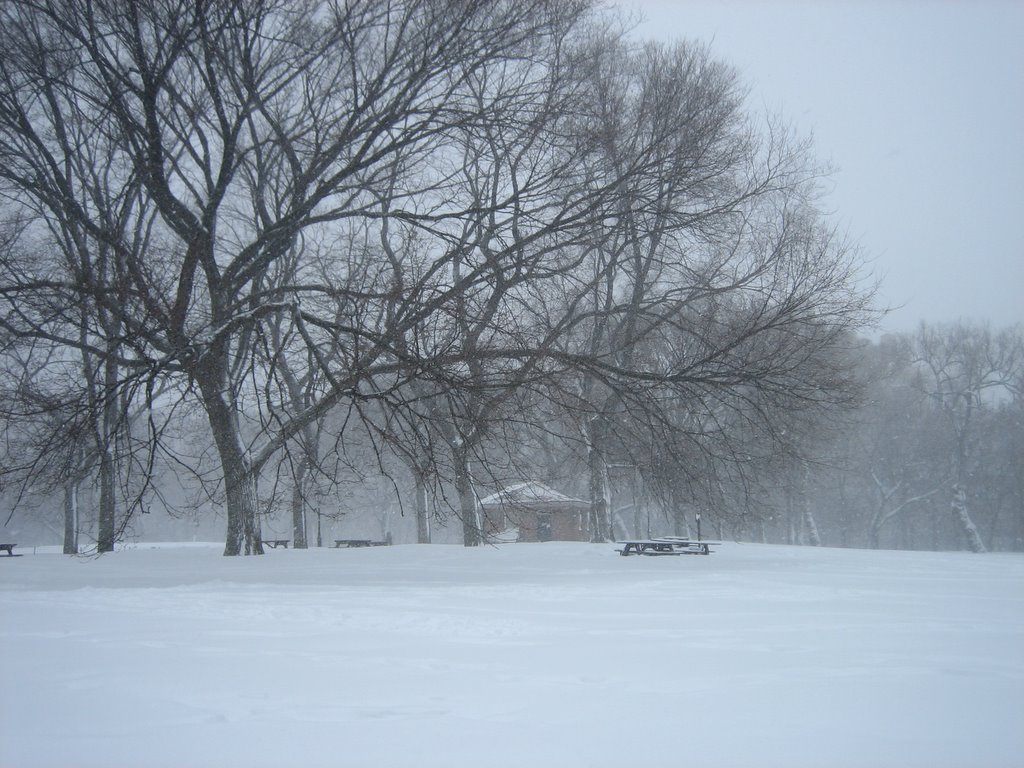
Blizzard of 2006, 12th February


The Snowfall Is So Silent
by Miguel de Unamuno
Translated by Robert Bly

The snowfall is so silent,
so slow,
bit by bit, with delicacy
it settles down on the earth
and covers over the fields.
The silent snow comes down
white and weightless;
snowfall makes no noise,
falls as forgetting falls,
flake after flake.
It covers the fields gently
while frost attacks them
with its sudden flashes of white;
covers everything with its pure
and silent covering;
not one thing on the ground
anywhere escapes it.
And wherever it falls it stays,
content and gay,
for snow does not slip off
as rain does,
but it stays and sinks in.
The flakes are skyflowers,
pale lilies from the clouds,
that wither on earth.
They come down blossoming
but then so quickly
they are gone;
they bloom only on the peak,
above the mountains,
and make the earth feel heavier
when they die inside.
Snow, delicate snow,
that falls with such lightness
on the head,
on the feelings,
come and cover over the sadness
that lies always in my reason.


Surely you desire truth in the inner parts;
you teach me wisdom in the inmost place.

Cleanse me with hyssop, and I will be clean;
wash me, and I will be whiter than snow.
Psalm 51:6-7

Wednesday, February 22, 2006

i carry your heart with me

Today I sat for my first quiz in three and a half years. What an odd feeling. Quizzes are such a distinctly American tradition (I managed to escape last semester because I only took seminars, but I'm taking more classes this term.) They take their testing very seriously in this country. Did you know that a "quest" is that which is between a quiz and a test? We certainly took no quizzes, quests or tests at Oxford. Only exams. Big exams. Also, the Spelling Bee is a national sport which many middle schoolers (and their parents) earnestly devote themselves to, in search of fame and spelling glory. All this brings to mind another country which also takes its testing very, very seriously. But in any case, I digress. I mentioned the quiz only because I felt so accomplished at having actually taken one, that after class I stopped by the video store and rented In Her Shoes. (I haven't rented anything since Christmas.)

I rather enjoyed the movie. It's one of those rare dramedies that's mainly about family instead of romance. The core relationship between two sisters, while histrionic at times, was mostly quite moving. In the DVD extras, the scriptwriter mentioned that what she loved about the book was something that isn't just true for sibling relationships or family relationships, but true for every relationship. And that is that the people whom you love best, who know you best, are the ones who can hurt you the most. This is the risk of loving.


It was C. S. Lewis who said: Love anything, and your heart will certainly be wrung and possibly be broken. If you want to make sure of keeping it intact, you must give your heart to no one, not even to an animal. Wrap it carefully round with hobbies and little luxuries; avoid all entanglements; lock it up safe in the casket or coffin of your selfishness.

To love at all is to be vulnerable.

It always amazes me how God chose to love us, how he willingly allowed himself to be vulnerable, firstly in the very act of creation and then later on the cross. For the very relationship of love is premised upon the existence of free choice, without that it would simply be compulsion. So we can choose to love God, but clearly we can also choose to reject him.


This movie will do for the poetry of e. e. cummings, what Four Weddings and A Funeral did for the poetry of W. H. Auden (Stop all the clocks...)

i carry your heart with me

i carry your heart with me(i carry it in
my heart)i am never without it(anywhere
i go you go,my dear; and whatever is done
by only me is your doing,my darling)
i fear
no fate(for you are my fate,my sweet)i want
no world(for beautiful you are my world,my true)
and it's you are whatever a moon has always meant
and whatever a sun will always sing is you

here is the deepest secret nobody knows
(here is the root of the root and the bud of the bud
and the sky of the sky of a tree called life;which grows
higher than the soul can hope or mind can hide)
and this is the wonder that's keeping the stars apart

i carry your heart(i carry it in my heart)


I think about how the most beautiful celebrations of love always carry hints of the transcendental.

I think about how the best aspects of earthly love always echo the eternal.

As Pope Benedict writes so utterly movingly in his first encyclical on Love: It is part of love's growth towards higher levels and inward purification that it now seeks to become definitive, and it does so in a twofold sense: both in the sense of exclusivity (this particular person alone) and in the sense of being “for ever”. Love embraces the whole of existence in each of its dimensions, including the dimension of time. It could hardly be otherwise, since its promise looks towards its definitive goal: love looks to the eternal. Love is indeed “ecstasy”, not in the sense of a moment of intoxication, but rather as a journey, an ongoing exodus out of the closed inward-looking self towards its liberation through self-giving, and thus towards authentic self-discovery and indeed the discovery of God: “Whoever seeks to gain his life will lose it, but whoever loses his life will preserve it” (Lk 17:33), as Jesus says throughout the Gospels (cf. Mt 10:39; 16:25; Mk 8:35; Lk 9:24; Jn 12:25). In these words, Jesus portrays his own path, which leads through the Cross to the Resurrection: the path of the grain of wheat that falls to the ground and dies, and in this way bears much fruit. Starting from the depths of his own sacrifice and of the love that reaches fulfilment therein, he also portrays in these words the essence of love and indeed of human life itself. [6]

Anyone who wishes to give love must also receive love as a gift. Certainly, as the Lord tells us, one can become a source from which rivers of living water flow (cf. Jn 7:37-38). Yet to become such a source, one must constantly drink anew from the original source, which is Jesus Christ, from whose pierced heart flows the love of God (cf. Jn 19:34). [7]


i carry your heart with me

i carry it in my heart

Wednesday, April 06, 2005

Goodbye Oxford

Just a gentle, quiet lament
for the time that has passed,
and friends that will be much missed.
For turrets that twist in the sky,
and bells that chime in the night.
For the river that will always flow,
and the spires that will forever dream.

I am so very thankful.


Tuesday, March 01, 2005

Between the Idea and the Reality

Exactly a week ago I found myself at St Catherine's College, listening to none other than Anwar Ibrahim speak. You heard me right. Anwar Ibrahim. Former Malaysian Minister of Finance and heir apparent to Mahatir, that is until he got chucked into jail on charges of corruption and sodomy. He's in Oxford now on a visiting professorship - it's so cool that Oxford draws the most eclectic people from far and wide. It was a really interesting talk, "From Paradiso to Inferno", touching on the years 1997-8 when the Asian Financial Crisis struck. I was quite impressed when he started off by quoting Dante:

A heavy clap of thunder startled me up
As though by force; with rested eyes I stood

Peering to find where I was--in truth, the lip
Above the chasm of pain, which holds the din
Of infinite grief: a gulf so dark and deep

And murky that though I gazed intently down
Into the canyon, I could see nothing below.


He spoke about what he did as Finance Minister and how he tried to push for reforms to the system so as to combat corruption. He said he met with great opposition, and he also basically said that it was his personal war on corruption that led to his fall: he was making it harder for the former PM to favour his own, especially his children.

He impressed me further by quoting Amartya Sen (Nobel Prize winner for Economics and formerly of Oxford) on his theory of development as freedom, and proclaiming that Asian Values were clearly overrated. Arguments about the need for example, to curtail freedom of speech in order to maintain racial harmony and guarantee national security have been used since the 1960s - surely we have moved on since then. He stressed the importance of freedom and democracy, specifically expressed in the institutions of an impartial judiciary and a free press, as the best way to fight corruption and encourage greater growth.

During the question and answer session I stood up and said "You say that the way to combat corruption is through having freedom and democracy. I was just wondering what you think about the experience of Singapore as compared to Malaysia in the fight against corruption, especially given the fact that Singapore is, well..." People started laughing, and because I'm so incredibly politically correct, I didn't go on to state the obvious. He smiled and said that clearly Singapore was much more successful than Malaysia in dealing with corruption. And this is something that Malaysia always has trouble admitting - that Singapore is better at it in anything. But he insisted that Singapore could still do with greater freedom. And besides, corruption is sometimes a matter of defintion, is it not? It made me think about how it is possible, while not breaking the letter of the law (and hence not being legally culpable) one is still clearly capable of breaking the spirit of the law.

He also spoke about the "Chinese problem" and the bumiputra policies. He said that there clearly needed to be more equality, and in the cases where there was to be affirmative action, it should apply equally to all races: the Indians on the plantations, the Chinese in the urban slums and the Malays in the rural areas. He said he'd often had arguments with fellow Malays about the matter, and he always pointed out how it was impossible to be a just Muslim if you were to deny, say for example, an accomplished Chinese student a seat at the university on the basis of race.

He was very funny and engaging and I could see why the Economist had said that he was the most charismatic Malaysian politician of his generation. He spoke about the difference in the extent of corruption in Indonesia and in Malaysia. In Indonesia they just ask you for bribes outright, but in Malaysia they were a bit more subtle. "We were trained by the British you see, the Indonesians were trained by the Dutch," he said, to much laughter all round. He talked about his time in jail. "There wasn't much to do in solitary confinement; read, sing, you name it, I sang it all, Elvis Presley and all that."

He looked perfectly fine and healthy which was surprising. He said he had been beaten quite badly in jail but that his operation in Germany had more or less got him back on his feet. He said that he did not regret anything that he did, except for the pain that it had inadvertantly caused his family.

Later on during tea at the Rector's Lodgings I got to speak with him. I asked him what role moderate Islam (as practised in Malaysia and Indonesia) had to play, in the light of the rise of Islamic fundamentalism. He said that he was writing a paper on that and that it would be published soon. I then asked him what he thought about Mahatir's incendiary and controversial comments about the West (I distinctly remember him accusing the Jews of conspiring against the Islamic states during the height of the financial crisis) and how he thought it affected relations between Islam and the West. He said that Mahatir was a clever guy and that he knew just how to appeal to Muslims all over the world. When you consider that their options are rather limited (Saddam, Osama, the Saudi King), it is not difficult to see why Muslims would respond positively to someone like Mahatir (a moderate in comparison).

I also had a chance to speak to his wife, Dr Aziza, MP of Penang as I understand it (yay Penang! I have family there :) She seemed really nice and gentle. I asked her what she thought was the role of women in an Islamic society. She spoke about how in the beginning there was Adam and Eve and that is the way God made it - men and women were meant to be partners in this world, but this did not mean that women should be treated like men. She talked about the differences between men and women, women had to bear children, biologically we have a different make-up etc. I asked her if that then meant that men and women have different roles in society, women at home and men in the workplace. She said that women should be in the workplace as well, but that differences should still be taken into account. Do you mean in terms of maternity leave, childcare subsidies and so on and so forth? Yes, she said, and she spoke of recent efforts to extend maternity leave.

She said that a man once asked the Prophet whom he should respect, and the Prophet replied "Your mother. Your mother. Your mother." Women were clearly worthy of great respect. But I kept wondering if, in conservative Islamic societies, it was the case that women only gained the greatest respect as mothers, and that implicit in all that she had said, was an admission that women could never really be "on par" with men, and that "difference" was just another word for inequality. She spoke about how it was important to be gentle and genteel and to be respected when conducting oneself in the political arena - that was how she got things done. But at the same time I wondered how much that respect was contingent on her being the wife of Anwar Ibrahim. Don't get me wrong, she seemed perfectly nice and respectable, and I'm thrilled that she's an MP, but I am still rather sceptical of the prospects of gender equality in a conservative Islamic state like Malaysia, at least for now.

Later that night I spoke to my dad and told him that I'd seen Anwar Ibrahim speak. We have lots of family in Penang (some of them rather well placed) and my dad told me that according to a very reliable source, Anwar Ibrahim had had a very mutually advantageous relationship with one of the prominent Chinese businessmen in Penang. It might not have been a case of straight out corruption, but like Mr Ibrahim himself said, it's a matter of how you define corruption, isn't it? Cherfarn said quite humorously and quite accurately that it was not a matter of whether you were muddy or clean, but how muddy you were, because everyone was dirty. It is a matter of degree, so where do you draw the line?

In his speech, Mr Ibrahim also quoted (much to his credit) T.S. Eliot. It was particularly apt.

Between the idea
And the reality
Between the motion
And the act
Falls the Shadow

- from 'The Hollow Men'


I was speaking to Dr Aziza when they had to leave. "Thanks for coming," she said, "And God Bless."

"Thank you," said I, "God Bless you too." I thought it was nice that we could say that to each other meaningfully, even though we had different conceptions of God.

I really enjoyed the session and it really made me think. They were both very pleasant and approachable, and I do hope to God, for his sake and for his country's sake, that Mr Ibrahim is innocent of what they charged him with. And also, that he truly means what he says.