Showing posts with label new york. Show all posts

Friday, June 05, 2009

How Tim Keller Found Manhattan

Great article about the wonderful story of Tim Keller, Redeemer Presbyterian Church and New York City. It's not hard to see why Dr Keller and Redeemer's ministry has grown so quickly and touched so many, myself included.

The Kellers stick to a few rules. They never talk about politics. Tim always preaches with a non-Christian audience in mind, not merely avoiding offense, but exploring the text to find its good news for unbelievers as well as believers. The church emphasizes excellence in music and art, to the point of paying their musicians well (though not union scale). And it calls people to love and bless the city. It isn't an appeal based on guilt toward a poor, lost community.

... Keller's reading of Scripture fueled his enthusiasm. Conn had taught him a positive biblical view of cities. As he studied New York, he began to draw out that understanding. Surely God's command to exiled Israelites applied to Christians in New York: "seek the peace and prosperity of the city to which I have carried you" (Jer. 29:7). Long before that, God had designated cities as places of refuge when Israel entered the Promised Land. They remain so today, Keller noted—which explains why poor people, immigrants, and vulnerable minorities such as homosexuals cluster in cities. They attract people who are open to change. Paul did most of his missionary work in cities, and early Christianity flourished within them. Revelation portrays the final descent of the kingdom of God to earth as a city, although a garden city, with fruit trees and a life-giving river at its center. Keller suggests that, had Adam and Eve lived sinlessly and obeyed God's directions, they would have made Eden into just such a city.
The New Jerusalem
Then I saw a new heaven and a new earth,
for the first heaven and the first earth had passed away,
and there was no longer any sea.
I saw the Holy City, the new Jerusalem,
coming down out of heaven from God,
prepared as a bride beautifully dressed for her husband.
And I heard a loud voice from the throne saying,
"Now the dwelling of God is with men,
and he will live with them.
They will be his people,
and God himself will be with them and be their God.
He will wipe every tear from their eyes.
There will be no more death or mourning or crying or pain,
for the old order of things has passed away."


He who was seated on the throne said,
"I am making everything new!"
Then he said, "Write this down,
for these words are trustworthy and true."

Revelation 21:1-5

Sunday, April 30, 2006

See! The winter is past (Sakura Matsuri)

Spring is well and truly here. Flowers are erupting into colour everywhere you turn. The sky shines the deepest blue and all the world is drenched in sunlight. The cherry blossom trees on campus are in full bloom, and not even deadlines and exams can get me down at this point. Speaking of cherry blossoms, we went down to the Brooklyn Botanical Gardens today for Sakura Matsuri 2006, the annual cherry blossom festival. Everyone was there to see over 200 cherry trees in full flower, among all the other flora and fauna, and I’m sure that no one was disappointed. The gardens were a riot of colour, and the flowers were just stunning. Looking at the cherry blossoms, each flower utterly perfect and delicately beautiful, it occurred to me that all the world is an open love letter from God to us, in all its pain and beauty.


It is in the depth of suffering that we know it is only the manna from heaven that will fill us, and only the springs of living water that will never run dry.

It is in the midst of beauty that our souls soar towards eternity, and we know, in the depth of our hearts, that no joy this profound could be an accident.


My lover spoke and said to me,
"Arise, my darling,
my beautiful one, and come with me.

See! The winter is past;
the rains are over and gone.

Flowers appear on the earth;
the season of singing has come,
the cooing of doves
is heard in our land.

The fig tree forms its early fruit;
the blossoming vines spread their fragrance.
Arise, come, my darling;
my beautiful one, come with me.
Song of Solomon 2:10-13

Friday, April 14, 2006

Maundy Thursday

I went with my fellowship group to a Maundy Thursday service at All Angels Church. We were all there to remember the night before the crucifixion, the night of the Last Supper, when Christ instituted the practice of taking communion and when he washed his disciples' feet. In rememberance of Christ, we (including the pastors), in pairs, took turns to wash each others feet.

[Jesus] poured water into a basin and began to wash his disciples' feet, drying them with the towel that was wrapped around him.

He came to Simon Peter, who said to him, "Lord, are you going to wash my feet?"

Jesus replied, "You do not realize now what I am doing, but later you will understand."

"No," said Peter, "you shall never wash my feet."

Jesus answered, "Unless I wash you, you have no part with me."

John 13:5-8

The pastor spoke about how we often try to deal with our own sin by ignoring it, or trying our best to live a good life, taking our salvation into our own hands, trying to work our way into heaven ("I am good, therefore God owes me"), or, we try to beat ourselves up and make ourselves feel bad, thinking that our guilt could wash us clean. But the surest way we know why none of these approaches could ever work, was because Jesus chose the cross. If there were any other way for the God of the universe to reconcile fallen humanity to himself - we who had wilfully rebelled against his rightful lordship - would he not have chosen that? It was not only Jesus who suffered infinitely on the cross, the Father's heart was wrenched apart also - for which father would not hurt to see his son suffer?

The words from the hymn Rock of Ages speak beautifully of this:

Not the labors of my hands
can fulfill thy law's commands;
could my zeal no respite know,
could my tears forever flow,
all for sin could not atone;
thou must save, and thou alone.

Nothing in my hand I bring,
simply to the cross I cling;
naked, come to thee for dress;
helpless, look to thee for grace;
foul, I to the fountain fly;
wash me, Savior, or I die.

It is only Jesus' atoning sacrifice on the cross, Jesus dying in our place, bearing upon himself the full punishment for humanity's sin - it is only Jesus' blood that washes us clean.

...When he had finished washing their feet, he put on his clothes and returned to his place. "Do you understand what I have done for you?" he asked them. "You call me 'Teacher' and 'Lord,' and rightly so, for that is what I am. Now that I, your Lord and Teacher, have washed your feet, you also should wash one another's feet. I have set you an example that you should do as I have done for you."
John 13:12-15

As I knelt at my friend's feet, I poured water into the basin, and taking each foot in turn I washed them. I thought about how Jesus humbled himself infinitely, washing the feet of his disciples, and ultimately, becoming a man and laying his life down for us. The Lord of the Universe knelt at his disciples' feet and washed them. Even washing the feet of the one who was to betray him. The great love that is evident in the laying down of his life for all at the crucifixion, is also demonstrated in the humble service of footwashing. It spoke powerfully of the new organising principle of God's kingdom, for Jesus' message was radically counter-cultural then, and it still is now.

Tim Keller put it most eloquently in one of his recent sermons, "The Openness of the Kingdom." Jesus proclaimed, ""The kingdom of God is near. Repent and believe the good news!" (Mark 1:15) Keller talked about how everytime a new leader comes in, he always brings with him new organising principles: new priorities, new values, new policies - things get done differently. What then, is the central organising principle of the kingdom?

The way up, is to go down
the way to influence and power, is not to seek influence and power,
but only to serve
the way to get rich is to give your wealth away
the way to be really happy, is not even to try to be happy,
but to try to make others happy
the way to reign is to submit
the way to magnificence of character, is humility
the way to find yourself - that is to really know that you are distinct, unique and valuable - is to not try to find yourself but to lose yourself in service to God and others
the way to be free, is to go to God and say, "Command me."

The kingdom of God is just the world turned upside down - it's the absolute reverse of how the world regards money, power, recognition, status, comfort and happiness.

It is the Lord of all the universe stooping to wash his disciples' feet.

It is the Lord of all the universe clinging to the cross, so that his blood may wash us clean.

Thursday, March 02, 2006

Tim Keller and Redeemer Presbyterian in the New York Times

The New York Times has published a write-up about my pastor and the church that I've been attending ever since I came to New York; Redeemer has been such a tremendous blessing to me and I am just so grateful for the whole community. The article was interesting and fair - I almost could not believe the New York Times managed to write about a leading evangelical (although Dr Keller prefers to be identified as "orthodox" because of all the negative political connotations of that word) and an evangelical church, with absolutely no hint of snarkiness. Talk about miracles.

Check out the article here: Preaching the Word and Quoting the Voice

Wednesday, March 01, 2006

The Last of Winter

Blizzard of 2006, 12th February


The Snowfall Is So Silent
by Miguel de Unamuno
Translated by Robert Bly

The snowfall is so silent,
so slow,
bit by bit, with delicacy
it settles down on the earth
and covers over the fields.
The silent snow comes down
white and weightless;
snowfall makes no noise,
falls as forgetting falls,
flake after flake.
It covers the fields gently
while frost attacks them
with its sudden flashes of white;
covers everything with its pure
and silent covering;
not one thing on the ground
anywhere escapes it.
And wherever it falls it stays,
content and gay,
for snow does not slip off
as rain does,
but it stays and sinks in.
The flakes are skyflowers,
pale lilies from the clouds,
that wither on earth.
They come down blossoming
but then so quickly
they are gone;
they bloom only on the peak,
above the mountains,
and make the earth feel heavier
when they die inside.
Snow, delicate snow,
that falls with such lightness
on the head,
on the feelings,
come and cover over the sadness
that lies always in my reason.


Surely you desire truth in the inner parts;
you teach me wisdom in the inmost place.

Cleanse me with hyssop, and I will be clean;
wash me, and I will be whiter than snow.
Psalm 51:6-7

Wednesday, February 22, 2006

i carry your heart with me

Today I sat for my first quiz in three and a half years. What an odd feeling. Quizzes are such a distinctly American tradition (I managed to escape last semester because I only took seminars, but I'm taking more classes this term.) They take their testing very seriously in this country. Did you know that a "quest" is that which is between a quiz and a test? We certainly took no quizzes, quests or tests at Oxford. Only exams. Big exams. Also, the Spelling Bee is a national sport which many middle schoolers (and their parents) earnestly devote themselves to, in search of fame and spelling glory. All this brings to mind another country which also takes its testing very, very seriously. But in any case, I digress. I mentioned the quiz only because I felt so accomplished at having actually taken one, that after class I stopped by the video store and rented In Her Shoes. (I haven't rented anything since Christmas.)

I rather enjoyed the movie. It's one of those rare dramedies that's mainly about family instead of romance. The core relationship between two sisters, while histrionic at times, was mostly quite moving. In the DVD extras, the scriptwriter mentioned that what she loved about the book was something that isn't just true for sibling relationships or family relationships, but true for every relationship. And that is that the people whom you love best, who know you best, are the ones who can hurt you the most. This is the risk of loving.


It was C. S. Lewis who said: Love anything, and your heart will certainly be wrung and possibly be broken. If you want to make sure of keeping it intact, you must give your heart to no one, not even to an animal. Wrap it carefully round with hobbies and little luxuries; avoid all entanglements; lock it up safe in the casket or coffin of your selfishness.

To love at all is to be vulnerable.

It always amazes me how God chose to love us, how he willingly allowed himself to be vulnerable, firstly in the very act of creation and then later on the cross. For the very relationship of love is premised upon the existence of free choice, without that it would simply be compulsion. So we can choose to love God, but clearly we can also choose to reject him.


This movie will do for the poetry of e. e. cummings, what Four Weddings and A Funeral did for the poetry of W. H. Auden (Stop all the clocks...)

i carry your heart with me

i carry your heart with me(i carry it in
my heart)i am never without it(anywhere
i go you go,my dear; and whatever is done
by only me is your doing,my darling)
i fear
no fate(for you are my fate,my sweet)i want
no world(for beautiful you are my world,my true)
and it's you are whatever a moon has always meant
and whatever a sun will always sing is you

here is the deepest secret nobody knows
(here is the root of the root and the bud of the bud
and the sky of the sky of a tree called life;which grows
higher than the soul can hope or mind can hide)
and this is the wonder that's keeping the stars apart

i carry your heart(i carry it in my heart)


I think about how the most beautiful celebrations of love always carry hints of the transcendental.

I think about how the best aspects of earthly love always echo the eternal.

As Pope Benedict writes so utterly movingly in his first encyclical on Love: It is part of love's growth towards higher levels and inward purification that it now seeks to become definitive, and it does so in a twofold sense: both in the sense of exclusivity (this particular person alone) and in the sense of being “for ever”. Love embraces the whole of existence in each of its dimensions, including the dimension of time. It could hardly be otherwise, since its promise looks towards its definitive goal: love looks to the eternal. Love is indeed “ecstasy”, not in the sense of a moment of intoxication, but rather as a journey, an ongoing exodus out of the closed inward-looking self towards its liberation through self-giving, and thus towards authentic self-discovery and indeed the discovery of God: “Whoever seeks to gain his life will lose it, but whoever loses his life will preserve it” (Lk 17:33), as Jesus says throughout the Gospels (cf. Mt 10:39; 16:25; Mk 8:35; Lk 9:24; Jn 12:25). In these words, Jesus portrays his own path, which leads through the Cross to the Resurrection: the path of the grain of wheat that falls to the ground and dies, and in this way bears much fruit. Starting from the depths of his own sacrifice and of the love that reaches fulfilment therein, he also portrays in these words the essence of love and indeed of human life itself. [6]

Anyone who wishes to give love must also receive love as a gift. Certainly, as the Lord tells us, one can become a source from which rivers of living water flow (cf. Jn 7:37-38). Yet to become such a source, one must constantly drink anew from the original source, which is Jesus Christ, from whose pierced heart flows the love of God (cf. Jn 19:34). [7]


i carry your heart with me

i carry it in my heart

Monday, February 20, 2006

The True Story

One of the other very striking things that Dr Ramachandra said on Thursday night, was that we should make use of our university years to establish firm, intellectual foundations for our faith. He noted that we ourselves might be the biggest stumbling block to thoughtful inquirers about the faith, with our superficial theology and our shallow understanding. I found this quite sobering.

Looking back, I see how the Lord has led me on this wonderful journey. I started out standing at the crossroads of faith and philosophy. I had always considered myself a Christian, but in my three years at Oxford I was steeped in secular philosophy, which left me rather confused for the first two years. In my third year I started, for the very first time in my life really, to fully grasp the truth of the gospel, emotionally and intellectually. I left Oxford convinced about Jesus, and convinced about the inadequacy of secular philosophy to bring about real, positive change, but I was not quite sure about what Jesus had to say to secular philosophy. In my six months or so in New York, God has been giving me some great answers.

I’m finding that my semesters have come to have certain themes to them. Last semester my philosophy classes covered the nature of justice, as well as secular liberalism and identity. This tied in very well with the Vision Campaign sermons at church which touched upon the nature of competing truth claims and the transformative power of the gospel. (See Liberalism, the Gospel and the Truth: Part One, Part Two). This semester, I’ve been taking courses in human rights, globalization, civil liberties and terrorism, and another course in modern philosophy. The focus is now more on the “practical” side of justice with a more global perspective. The Veritas Forum came along at just the right time – the speakers who came were all actively on the front lines of human rights and global justice, and it was fascinating to hear what they had to share. This semester, my human rights course in particular, has provided me with much food for thought.

We recently read one of Richard Rorty’s lectures, Human Rights, Rationality and Sentimentality (On Human Rights: Oxford Amnesty Lectures 1993). Rorty is a prominent atheist and a self-described “neo-pragmatist”. His philosophy is anti-metaphysical: he believes that the traditional philosophical pursuit of ultimate, objective, foundational knowledge (especially regarding the existence of God), is misguided and ineffective. In this article, he argues for a pragmatic approach in establishing the basis of a human rights culture.

He cites a report about the atrocities in Bosnia, commenting that Serbian murderers and rapists not think of themselves as violating human rights, for they are not doing these things to fellow human beings, but Muslims. They are not being inhuman, but rather are discriminating between the true humans and the pseudo-humans. As Clifford Geertz puts it, “Men’s most importunate claims to humanity are cast in the accents of group pride.” By default, we tend to think of our humanity is a tribalistic and ethnocentric way – we think in terms of “them” and “us”.

He notes that outside the circle of post-Enlightenment European culture, most people are simply unable to understand why membership in a biological species automatically qualifies a person of another culture, one of the “others”, as a member of our moral community. On Thursday, Dr Ramachandra also similarly argued that the moral equality and dignity of all is not a concept that is innate to most cultures at all. India and China had extremely hierarchical, class-based societies, and most cultures are inherently tribalistic. Any culture that respects universal human rights, regardless of ethnic boundaries, have all, historically, been influenced by Judeo-Christian thought. The philosophy of the Enlightenment is deeply steeped in Judeo-Christian tradition. For example, Kant’s account of the respect due to rational agents tells us that you should extend the respect you feel for people like yourself to all “featherless bipeds”. Rorty goes on to say “This is an excellent suggestion, a good formula for secularizing the Christian doctrine of the brotherhood of man.” (See The Veritas Forum at ColumbiaA slight diversion: Secular Humanism as a Christian Heresy).

He points out that “most people – especially people relatively untouched by the European Enlightenment – simply do not think of themselves as, first and foremost, a human being. Instead, they think of themselves as a certain good sort of human being – a sort defined by explicit opposition to a particularly bad sort.” Ironically, this is also true of the very Western intellectuals who have been touched by the European Enlightenment. Rorty says “I quite agree that [our Western human rights culture] is morally superior…” and “We Eurocentric intellectuals like to suggest that we, the paradigm humans, have overcome this primitive parochialism by using that paradigmatic human faculty, reason.”

But Rorty has a problem with the appeal to reason to justify human rights. Kant, following Plato, emphasised rationality as essential to being human. Plato believed that the best way to deal with immoral people was to demonstrate to them that they had an interest of which they were unaware, an interest in being rational, in acquiring self-knowledge. Plato saddled us with a distinction between the true and false self. That distinction was, by the time of Kant, transmuted into a distinction between categorical, rigid, moral obligation and flexible, empirically determinable self-interest. Kant claims that sentimentality has nothing to do with morality, that there is something distinctively and transculturally human called “the sense of moral obligation” which has nothing to do with love, friendship, trust or social solidarity.

Rorty thinks that appealing to common rationality as the basis for respecting human rights does not work. It does not do much good to get tribalistic, ethnocentric people to read Kant, and agree that one should not treat rational agents simply as means. For everything turns on who counts as a fellow human being, as a rational agent in the only relevant sense – the sense in which rational agency is synonymous with membership in our moral community. For most white people, until very recently, most Black people did not so count. For the Nazis, Jews did not so count. For the Serbs, Muslims did not so count. He says, “Even if we do think that all human beings are rational, we tend to equate “human beings” with “member of our tribe”, we have always thought of human beings in terms of paradigm members of the species. We have contrasted us, the real humans, with rudimentary, or perverted, or deformed examples of humanity.”

Rorty’s solution is to give up rationality for sentimentality. He follows Hume in believing that “corrected sympathy, not law-discerning reason, is the fundamental moral capacity.” He cites contemporary philosopher Annette Baier, who would like us to get rid of both the Platonic idea that we have a true self, and the Kantian idea that it is rational to be moral. Instead, she advocates a Humean “progress of sentiments”, which consists in an increasing ability to see the similarities between ourselves and people very unlike us as outweighing the differences. Rorty calls this “sentimental education” and he describes it as manipulating the sentiments of future generations by telling them long, sad, sentimental stories which typically begin “Because this is what it is like to be in her situation – to be far from home, among strangers,” or “Because she might become your daughter-in-law,” or “Because her mother would grieve for her.” It is novelists and stories that best capture our imagination and engage us morally, and Rorty believes that this is the best catalyst for change.

Reading this article it occurred to me, that the only way in which a story could both capture our sentiments and grip our reason, and really change our lives, is if it were about us, all of us, (and not just some distant, almost hypothetical "other"), and if it were true.

I think that Rorty’s dichotomy between sentimentality and rationality is a false one. It was the great C. S. Lewis who understood so very clearly that we have both the heart that yearns for God and the mind that seeks to know him. Lewis himself grew up loving the Greek and Norse mythology of old, but it was only after his conversion that he started to see in them glimpses of eternal truth.

Colin Duriez writes that it was J. R. R. Tolkien who helped him to see this, during a long night's talk in September of 1931. Tolkien argued that the Gospels have a satisfying imaginative as well as intellectual appeal, demanding a response from the whole person. He accused Lewis of an imaginative failure in not accepting their reality. What Tolkien did was help Lewis see how the two sides, reason and imagination, could be integrated. During the two men's night conversation on the Addison Walk in the grounds of Magdalen College, Tolkien showed Lewis how the two sides could be reconciled in the Gospel narratives. The Gospels had all the qualities of great human storytelling. But they portrayed a true event—God the storyteller entered his own story, in the flesh, and brought a joyous conclusion from a tragic situation. Suddenly Lewis could see that the nourishment he had always received from great myths and fantasy stories was a taste of that greatest, truest story—of the life, death, and resurrection of Christ.

Lewis himself later argued in "Myth Became Fact," that “[t]he heart of Christianity is a myth which is also a fact. The old myth of the Dying God, without ceasing to be myth, comes down from the heaven of legend and imagination to the earth of history. It happens—at a particular date, in a particular place, followed by definable historical consequences. We pass from a Balder or an Osiris, dying nobody knows when or where, to a historical Person crucified (it is all in order) under Pontius Pilate. By becoming fact it does not cease to be myth: that is the miracle. … God is more than god, not less: Christ is more than Balder, not less. We must not be ashamed of the mythical radiance resting on our theology. We must not be nervous about "parallels" and "pagan Christs": they ought to be there—it would be a stumbling block if they weren't. We must not, in false spirituality, withhold our imaginative welcome.”

I was reminded of my favourite Tocqueville quote where he says, in a draft for the 1840 Preface to Democracy in America, 'Not a man in the world has ever found... the central point at which all the rays of general truth (which come together only in God) or even all the rays of particular truth meet. Men grasp fragments of truth, but never truth itself.'


Plato was right. We do have a true self.

(Charles Williams, Lewis' fellow Inkling, wrote about how the lover's romantic vision of the beloved was not confused, but illuminated. The lover sees through the beloved's flaws to the image of God. It is this truest and deepest self of the person - the person as created and potentially redeemed by God - that Williams called that person's "eternal identity.")

Kant was right. It is rational to be moral.

Hume was also right. Sentimentality matters to morality.

But they have only grasped fragments of the truth, which seem to contradict each other.


Tocqueville was right.

It is only in God, where all the rays of general and particular truth meet.


Postscript: Amazing. Just got back from church. Tonight, there was this guy who shared his experience of doing mission work, helping street boys, in Mexico City. He started out talking about how he came to faith. He was raised in a nice, secular family. He loved history and science and he only read nonfiction, because he thought that fiction was just a bunch of made-up stories with no real point to them. This is what he thought about religion for the longest time. But when he found himself confronted with the truth of Jesus Christ, he came to see that this was not just another story. It was, as C. S. Lewis said, a myth that was true. And that just totally changed his life.

Tuesday, February 14, 2006

The Veritas Forum at Columbia

What is a Veritas Forum?

Veritas Forums are university events that engage students and faculty in discussions about life's hardest questions and the relevance of Jesus Christ to all of life.

We invite people with differing worldviews, religions, and ideas to participate, ask questions, and join discussions in order to explore true life together, and we encourage participants to bring friends who are engaged in the exploration of life’s hardest questions.

From: www.veritas.org

“What is the biggest problem among today’s students?” Billy Graham recalled asking former Harvard president Derek Bok. The president answered, “Emptiness.” Started up by a group of Harvard students (hence Veritas, which is their school motto) in 1992, in response to the culture of fragmented scholars experiencing this “emptiness” within their own community, Veritas has taken root in more than over 50 campuses across America.

Exactly a week ago at Columbia, we had our annual Veritas forum –
“Exploring True Life. Responding to Suffering.”
This was my first Veritas Forum, ever, and I have just been so blessed by it. It was truly a privilege to grapple with some of life’s toughest questions in the company of very many distinguished speakers, alongside people of differing worldviews. I think that it is in engaging each other in respectful, meaningful conversation, that we all come to understand more of what is indeed, true life.


People Suffer – Who Cares?
A Secular Humanist and Christian Dialogue

The first session on Monday saw Professor Philip Kitcher, the Columbia University John Dewey Professor of Philosophy, in conversation with Dr. Vinoth Ramachandra, a theologian from Sri Lanka who has worked for decades among the destitute of his war-torn island.

Dr. Ramachandra started out by sharing some of his experiences with suffering – experiences that most of us are fortunate enough not to encounter daily, if at all. He spoke of comforting a friend who had lost her whole family to the tsunami, sitting by a four-year old child and watching him die of a disease that doesn’t exist in the West anymore, dealing with violence and tragedy on a daily basis, and watching his aged father slide further and further into dementia. I could feel my heart sink further with every illustration of the suffering that he has encountered. There is so much pain in this world, and yet for the most part, we are blissfully blind to it all.

Dr. Ramachandra was trained as a nuclear engineer in London, but he gave up a comfortable academic career to return to Sri Lanka. He spoke about how he has been passionate about the physical sciences ever since he was a boy. But, if science is the total truth, and all existence is a bizarre accident with no meaning, striving for justice is meaningless, because all people, good and evil, will suffer the same fate in the burning up of the sun, and in the end no one will be around to remember anything.

Nietzsche saw that all talk of human dignity and equality, upon which notions of justice are based, was a legacy of Judeo-Christian thought. We care, because God cares. Jesus’ crucifixion on the cross to cover our sins, tells us that God’s power is found in the mess that we’ve made of the world. God is a God who is not immune to suffering – God himself is to be numbered among the victims and not the oppressors. Human sin – the senseless attempt to live as if we were God and rejecting His rightful rule over our lives – is the prime evil. Dr. Ramachandra argued that the Bible does not even attempt to explain the origin of evil, for you can only explain the reasonable. Our turning against God, who loved us into existence and sustains us moment to moment, is absolutely irrational and absurd. It is because of our alienation from God that evil exists. Evil is irrational and unjustified. It is not be understood, but fought.

We live in the tension between the crucifixion and the resurrection. Jesus’ rising from the dead is the vindication and renewal of the created order, the redemption of all history, and God’s concrete promise that he will make all things new. We now live between the time where God suffered for us on earth and the eventual dawning of a new day. Remembering what God has done for us, and holding fast to His promises, we share in His indignation against injustice, and we turn from self-pity and apathy to action.


The problem of evil

Philip Kitcher responded by raising the age-old “problem of evil”. If God is good, why does He allow evil? Is it because He cannot prevent it? Then He is not all-powerful. Is it because He does not want to prevent it? Then He is not all good. This problem of theodicy has been discussed by countless philosophers far more distinguished than I throughout the centuries – there is not enough space (on this page and in my mind) to survey all that thought now, and I certainly do not profess to have the definitive answer.

However, I attended a debate at the Oxford Union sometime last year, between William Lane Craig and A. C. Grayling, about this very same topic. See Knowing Enough and The greatest thing you'll ever learn...

The gist of the response was that we are made in the image of God, so we have been given free will. The essence of sin is that we choose to reject God. We also considered the limits of human knowledge, especially with respect to finite minds trying to fathom the infinite.

I know that we do not know everything, but I think that we know enough. Now, I also think that if we could fathom God completely, he would surely cease to be God and become more a product of our imagination.

Prof. Kitcher then posed the question – if God is omnipotent, why did could he not create free-willed beings who always chose correctly? But of course, omnipotence does not mean enabling logical contradictions, and choice is not choice if you only ever choose the same thing. Also, I’ve read more recently, and very intriguingly, that free choice is absolutely necessary for true, genuine love. God made us such that we can experience the deepest joy, which is to have a relationship with him – to love him and to be loved by him. If we had no real choice, then there would be no genuine relationship of love. God gave us the ability to choose to truly love him, in the very same way that he chose, at infinite cost to himself, to love us.

Prof. Kitcher described morality as a great, ongoing, work-in-progress of which religion is only a part – none of the thinkers have told us the final story yet. Morality comes from the deep altruism within us, and we can also find primitive similar impulses in animals. We should combine all the best of human thought so that we can refine all the altruistic impulses within us.

One of the participants raised a very interesting question in response to this claim during the Q & A section. He pointed out that if we see morality as an ongoing project, of which we are the ultimate creators and ultimate judges, how will we know if we have improved from where we were before? It seems to me that we do in fact need absolute standards in order to judge “progress”.


The problem of the intrinsic lovability

Prof. Kitcher also argued that we should love people because they are intrinsically lovable and worthy – it is appalling to think that you can only love someone because they bear the image of God. We should do the best we can without any myths and stories and intractable logical problems about a good God who allows evil.

The moderator pointed out that Christians didn't see a distinction between loving people for who they are and loving them because they are made in the image of God. A large part of who they are is that they are made in the image of God. Dr. Ramachandra asked Prof. Kitcher what were his grounds for claiming that people were intrinsically lovable. He pointed out that in the history of Western thought, concepts of intrinsic dignity and inherent worth were only introduced with the arrival of Christianity. Until early Christianity took hold in the Greco-Roman world, philosophers like Plato and Aristotle advocated hierarchical societies made up of individuals of different intrinsic worth (some people were born to be slaves, while others were born to rule). The equality and dignity of all is not a natural assumption everywhere – India still has remnants of the caste system which relegates a certain class of people as a “sub-species”.

Prof. Kitcher insisted on the notion of intrinsic lovability as a free-standing claim with no need for cumbersome metaphysics, but Dr. Ramachandra pointed out that you would still, in the end, have to go back to the “metaphysics” and the foundational claims because how else would you convince people with a totally different worldview to contribute scarce resources to “intrinsically unequal” beings? Prof. Kitcher said that we could convince them by showing them the potential these people have to contribute towards society if they were just given the chance. Dr. Ramachandra said that he now seemed to be valuing people instrumentally, based on what they can give to society. But what about the elderly or the disabled?

Prof. Kitcher insisted on things being intrinsically valuable even though they were transient – it’s not only some kind of transcendental source that can give value. He didn’t really elaborate this particular claim, and I personally think that it is quite problematic. Without an external, objective, transcendental source that confers value, we humans would be the ultimate judges of value, and that would simply allow for far too much cultural and moral relativity – you still would not be able to convince, for example, certain high-caste members in India that the untouchables are equally worthy of love and respect as they are. Everyone would simply appeal to their own judgment and culture and tradition, and who is to say that I am more “right” than you are?


Secular Liberalism as a Christian heresy

Dr. Ramachandra pointed out that it is easy for Prof. Kitcher to assume the universal acceptability of the notion of the intrinsic worth of every human being, because he is very much shaped by Western liberal thought, which, in and of itself, owes a lot of its beginnings to the teachings of Christianity. Dr. Ramachandra said that John Gray (Professor of European Thought at the LSE), who is no Christian, pointed out that secular humanism was nothing more than a Christian heresy. The Guardian reviewer of John Gray’s book, Heresies, writes: Gray evinces a Swiftian contempt for our latter-day lay priestlings, direct heirs of the 18th-century philosophes who proclaimed a new paganism but were in fact neo-Christians, "missionaries of a new gospel more fantastical than anything in the creed they imagined they had abandoned". All the Enlightenment did was to promote religion by other means, and its belief in progress was only the Christian message "emptied of transcendence and mystery". One of the heresies promulgated by Gray is that many of those who today continue to hold to religious faith are far more profound in their thinking, and certainly better educated, than most of their liberal-humanist opponents.

books.guardian.co.uk/review/story/0,12084,1295980,00.html

In my reading, I’ve also come across a fantastic quote by Clifford Orwin, discussing the thought of one of the leading secular liberals of our time: “Richard Rorty, the leading postmodern liberal theorist, …concedes that liberalism, once so jealous of its autonomy from Biblical faith, is in fact parasitic upon it. In his essay “Postmodern Bourgeois Liberalism,” he describes secular liberals like himself as “freeloading atheists.” They continue to rely on the Judeo-Christian legacy of concern with human dignity despite their rejection of the revealed truth that alone could support this concern… For Rorty, God is dead but secularized Christian morality continues.”


A slight diversion: A discussion of John Rawls and limits of Liberalism

The widely acclaimed John Rawls, who with the publication of his book A Theory of Justice was proclaimed the modern saviour of liberalism, seemed to have been sensitive to this problem of fundamental justification. In his book on human rights, The Law of Peoples, published almost 30 years after he wrote A Theory of Justice, Rawls envisions a global world order in which he interestingly does not advocate any sort of “global liberalism”. He makes allowances to tolerate what he calls “decent hierarchical societies” based on a shorter, more basic list of human rights (as opposed to the more comprehensive doctrine of liberal constitutional democracy that he proposes in A Theory of Justice). I think that it is extremely telling that Rawls saw the difficulty of promoting worldwide liberalism in the face of very divergent fundamental worldviews. (How would one convince any of the Islamic states of the superiority of the Western liberal model?) There were many who thought that towards the end of his life Rawls must have lost it – they saw The Law of Peoples as a cop-out – but I think that he was being very prescient and very realistic about the limitations of his theory.

Rawls’ theory of justice has been described as a reworking of Kant without the metaphysics. He wants to build a theory based on an overlapping consensus about the good, without having to delve too far into cumbersome metaphysics or anything of the sort. But of course built into the very foundations of his theory are countless liberal assumptions. His hypothetical mechanism of the ‘original position’, which is used to generate the basic principles of justice, is sometimes thought of as a “neutral” mechanism.

The rational calculators in the original position are behind a “veil of ignorance” – they do not know their gender, intelligence, position in society, religion etc, and they are asked to choose basic principles upon which society will operate. In deriving his basic principles of equal respect and of fair equality of opportunity from this hypothetical construct, Rawls seems to want to procede from socio-economic facts about the human condition to principles of justice. G. A. Cohen (Chichele Professor of Social and Political Theory, Oxford University), argues in a forthcoming book, that Rawls here confuses the principles of justice with optimal rules of social regulation. The fact that people are different in their abilities and beliefs and desires, makes it socially optimal that we construct a society that allows for different kinds of flourishing, but he argues that the fact of diversity in and of itself does not justify the principle of equality. After all, there have been many regimes and ideologies that recognised the fact of diversity but chose instead to brutally suppress it. The reason why any fact supports any principle is explained by a further, ultimate, fact-insensitive principle. (G. A. Cohen argues for this in his article, Facts and Principles). So the reason why the fact of diversity would lead us to support the principle of equality must be grounded upon a more ultimate principle like the value of human dignity and autonomy – two very “liberal” and very loaded claims.

I think Rawls realised that ultimate principles about the value of human autonomy were not accepted by all peoples – certain societies have a more “associationist” account of flourishing which sees people assigned specific roles in society (based on gender, class etc). The different, ultimate claims about the kind of value that human life has cannot be adjudicated by recourse to fact, and are extremely difficult, perhaps impossible, to reconcile. I am inclined to think that it is with these considerations in mind that Rawls wrote The Law of Peoples, in which he advocated tolerance of decent, though illiberal, societies.


Conclusion

I think that Prof. Kitcher speaks hastily when he denies the great influence that Christianity has had on the development of secular humanism, and when he argues that claims about the intrinsic lovability and worth of all human beings are “free-standing”, and in no need of further justification. It is perhaps the privilege of we who have grown up in liberal Western societies (I use this term somewhat loosely…) to simply accept the equal dignity of all as brute fact, but we must never deceive ourselves into thinking that the rest of the world naturally sees things the way that we do, or that they can be easily convinced of our views without any discussion of more fundamental claims about “cumbersome metaphysics”, or perhaps even, a discussion about God.


Publishing the Cries of the Oppressed
On the Front Lines of Human Rights Journalism

Nicholas Kristof on Darfur

Almost as if to prove Dr. Ramachandra right, the next night we had two very distinguished human rights journalists speak to us about the horrors of genocide. Nicholas Kristof, a columnist for The New York Times and winner of a Pulitzer Prize for his coverage of China’s Tiananmen Square democracy movement, spoke about the absolutely horrific genocide in Darfur, in western Sudan. Mr. Kristof was one of the first journalists to raise the alarm bell about the genocide in Darfur, and he is currently collecting pledges to send Bill O’Reilly, a major news network anchor, to Darfur. It’s partly a joke, but it’s also about naming and shaming the major broadcasters in an effort to get them to take their cameras and news crews into places like Darfur.

Mr. Kristof spoke of his own visits to the country, speaking to the displaced peoples and hearing countless stories of violent brutality and unspeakable horror. The government, in cahoots with the militia, are systematically wiping out the non-Arab African tribes. Rough estimates tell of 300,000 people having been systematically killed off, and 2 to 3 million people being displaced. Those who are alive all tell similar harrowing tales of assault, rape and slaughter. Mr. Kristof said that it was clear that the Sudanese government made the calculation that the death of a few hundred thousand in rural Sudan would not warrant the “trouble” of international intervention – so far they have been proved chillingly correct.

Check out: www.savedarfur.com

Mr. Kristof’s description of the situation in Sudan proves how heartbreakingly true it is, as Dr. Ramachandra argued, that beliefs about the intrinsic human worth and inviolability are not “natural” to all people.


Benedict Rogers on Burma and East Timor

Christian Solidarity Worldwide: www.csw.org.uk

Benedict Rogers, a freelance journalist and human rights activist spoke of the persecution of Burma’s ethnic minorities, which he says is basically genocide. He spoke of Burma as one of the most under-reported countries in the world, even though it is known to be one of the worst violaters of human rights. He said that all the people he spoke to there all say the same thing – ‘Thank God you’re here! We thought we had been forgotten’, and, ‘Please tell the world about us, please do not forget us.’

Mr. Rogers professed that he had become quite the Bob Dylan fan, citing his lyrics from Blowin' in the Wind:

How many ears must one man have
before he can hear people cry?
How many deaths will it take till he knows
that too many people have died?
How many years can some people exist
before they’re allowed to be free?
How many times can a man turn his head,
pretending he just doesn’t see?

He showed us photographs of people that had been used as human minesweepers, children who’d been kidnapped and forced to be child soldiers, villages burned to the ground, a child’s drawing of what he had seen – men being shot, women being raped, babies being crushed to death in rice pounders.

During a public speech a few years ago, a senior Burmese general spoke of the regime's desire to eliminate all opposition. "In 10 years, all Karen will be dead," he threatened. "If you want to see a Karen, you will have to go to a museum in Rangoon."

Another Burma Army commander, speaking after he had led an attack on a village—slaughtering people and urinating on the head of a villager—summed up the spirit of the SPDC: "I do not respect any religion. My religion is the trigger of my gun."

From Burma’s Almost Forgotten by Benedict Rogers
www.christianitytoday.com/ct/2004/003/7.52.html

That the West has come to embrace a system of belief that upholds the equality and dignity of all, without a necessary belief in God, seems to me to be a fortuitous culmination of historical forces, of which Christianity is a very important one (perhaps even the most important). Other cultures that have taken a different historical trajectory have not necessarily come to the same conclusions about human dignity and worth. It was Nietzsche who saw that the only logical consequence of the “death of God” and of the subsequent death of the morality that is rooted in the transcendental objectivity of God is that “This world is the will to power – and nothing besides!”

And this power can be used towards unspeakable ends.

Benedict Rogers also spoke movingly of the faith of those whom he had encountered – an unwavering faith that God is still with them, an unwavering faith that God will deliver them. Ending on a more positive note, Mr. Rogers spoke of East Timor. He was there the night the nation was formed. The account that he shared is very similar to what he writes here: It was midnight on May 20, 2002. The flag had just been raised, the national anthem sung, and the world’s newest nation was born. I turned to the man next to me, a priest who was the first from his country to be exiled. His name was Rev. Francisco Maria Fernandes, and he’d lived in exile for a quarter of a century. Had he ever believed he’d live to see the day when his country would be free? “Yes, I did,” he smiled. “All around the world, during our struggle, people asked me: ‘Why do you carry on? You are fighting a losing battle. The world will never help you; the oppressors will never let you go. Why don’t you just give up?’ But we had one thing those people did not know about. We trusted God. This was a victory of faith.”
www.crisismagazine.com/september2004/rogers.htm


Who Will Solve the Problem of Poverty? Bono, Bill Gates, You?
A Conversation with Jeffrey Sachs, Larry Reed and Vinoth Ramachandra

On the last night of the forum, we moved from theological and philosophical ideas, and issues about reporting atrocities and making them known, to discussing the widespread suffering caused by extreme poverty, and what we can do about it.


Larry Reed

www.opportunity.org

Larry Reed of Opportunity International Network, a global microfinancing coalition that provides affordable loans to the poor, spoke about how his faith had moved him to make a career out of poverty relief. He spoke about how we need to see the poor as part of the solution – not simply as the problem. He spoke touchingly about the people that Opportunity International worked with in the Third World, how all they needed was a little bit of help to get going. He also spoke about how Jesus has a radical concern for the poor, and how that when we serve others, especially the poor, we fulfill our purpose and we touch the very heart of God.


Jeffrey Sachs
www.earthinstitute.columbia.edu

Next up was the “star” of the evening – Professor Jeffrey Sachs, Director of The Earth Institute, Director of the UN Millenium Project, Professor of Health Policy and Management at Columbia University, and good friend of Bono and the Make Poverty History celebrity crew. He talked about extreme poverty in Africa. He said that Africa needs, firstly, better agricultural technology, which does not involve advanced machinery, but simply high yield seed varieties, fertilizers and better water management. Secondly, better disease control – 2 to 3 million a year die of malaria and other diseases that have virtually been eliminated in the West. Thirdly, increased connectivity in terms of everything from roads to internet access is also vital to economic progress.

He spoke forcefully about how we do in fact have the resources and the ability to fight poverty effectively, if only we can get our act together and do something about it. He showed us pictures from his numerous trips to Africa. And the one that will haunt me for a long time to come was a picture of toddlers lying in rows on colourful blankets in a spartan room. In close-up pictures of individual toddlers, you could see their eyes half-open and rolled back in a feverish stupor – these rows of children were all in malarial comatose. They were waiting to die.


A slight diversion: Reflections on the absurdity of sin

Professor Sachs looked like a man who was heavily burdened with all the cares of the world. There was a distinct tone of incredulity, of disbelief, in his voice when he spoke about how achievable and how affordable poverty relief is, and yet, time and time again, the rich just turn their backs on the poor. We turn our backs on each other. Children die of malaria, day after day after day, he said, and it just goes on and on and on. Henry Shue, when arguing for subsistence rights in his book Basic Rights, cites Coleridge saying that the poor will merely "die so slowly that none call it murder."

We can do something about it, but we don’t. These are our fellow human beings, but we just don’t care enough. What is wrong with us? It was at this point that I began to understand a little bit more of what Dr. Ramachandra meant by the absurdity of sin. In our self-absorption, in seeking to rule our own lives, our way, we turn away from God, and we turn our backs on each other. If we take selfishness as a brute fact of the human condition, then we are certainly not “irrational” in the means that we employ to achieve our selfish ends – no, we are perfectly rational in that. But what I think Dr. Ramachandra means here, is that if there is a God who created us and who loves us with an everlasting love, and if he created us all as his children through the redemptive work of Christ, then certainly, there is something intrinsically absurd about our sinful selfishness. It is utterly absurd for us to reject his love and to neglect, even actively harm, each other.


Vinoth Ramachandra

Dr. Ramachandra spoke last. He said he fully endorsed what Prof. Sachs had said. He started by talking about how we could understand the rights of the poor. In the 13th century, before any global human rights movement, Saint Thomas Aquinas argued that in cases of need, all things are common property – need alone constitutes the poor man’s right. When the poor steal from the rich it is not theft, for God gave the world to us all. In fact, I am committing theft so long as I refuse to share with my needy neighbour, for the right to life trumps the right to personal property. The poor claiming their rightful entitlement is not simply benevolent generosity or enlightened self-interest on our parts, it is a matter of justice.

He talked about how most of the economic flows in the world are from poor to rich – debt repayment, agricultural tariffs, MNC profits, corrupt politicians squirreling money away to first world tax havens, the brain drain of educated professionals etc. He argued that justice for the poor must be seen in the wider context of shalom, the concept of full human flourishing described in the Bible. Shalom characterises a right relationship with God, with all of creation, with others and with ourselves. Poverty must be understood as a lack of resources overall, for grave economic inequality undermines social solidarity. We cannot separate discussions of poverty from social inequality and domination. A relational approach to poverty would focus, not just on the ends, but also on the means of economic improvement – there is a need to dismantle the relations of domination and exploitation that currently exist in the global economic system.

Perhaps, just perhaps, said Dr. Ramachandra, we need the poor far more than they need us.

We need them to show us our irrationality, our wastefulness, our emptiness, our greed, and our idolatry.

Maybe, just maybe, we are the ones that are in need of human development.

Wednesday, February 01, 2006

Happy Chinese New Year: A Certain Hope

We celebrated Chinese New Year with 4 consecutive days of (over)-eating, culminating in a big potluck party in our building where everyone demonstrated, most admirably, their culinary skills. Cherfy and I went on a big shopping spree in the depths of Chinatown (for truly, that's where all the good groceries can be found - not in the touristy bits) and we made char kway tiao and gulau melaka. More accurately, I followed Cherfy's competent instructions as best as I could (I am sous-chef, she is master chef, or, master Cherf - excuse the corniness, it's a festive-holiday affliction). Our dishes turned out great, and Cherfy also baked lots of scrumptious Chinese cookies. She is indeed culinary goddess.

Because three and a half years overseas turns almost everyone into culinary god/ goddess, we also had super yummy Indian curry, Hainanese chicken rice, fried bee hoon, dates wrapped in bacon, and nasi briyani. One of our friends also bought some excellent fried chicken wings. We even managed to buy a lo hei set from a Malaysian restaurant in Chinatown, and so we all happily tossed away.

We also had three steamboats going with all kinds of meat, seafood and vegetables. For desserts we had brownies, peppermint cake, our gulau melaka, and delicious cakes from Payard (fancy-pants Upper East Side bakery). We had about 20 people crowded onto our floor - it's a good thing that we live on the mezzanine because the little indoor balcony area just outside our kitchen afforded us with extra space. And because we had so much food, the very next day we had a leftover party. So really, we had prepared exactly double the amount of food that we needed. We all decided that it was a very good sign that we had started out the year with such abundance.

There was much merriment and festivity, but towards the end of the night it was also tinged with a distinct sense of regret and nostalgia. This was to be, for many of us, our last Chinese New Year overseas, our last year away from home. And in any leaving and returning, there is always a bittersweetness in letting go of one place and returning to another. In all the years of flying back and forth between the two sides of the earth this has become a familiar sensation, and yet this time around it is compounded because we are going back for good. Of course I am greatly looking forward to spending time with family and friends after such a long separation, but at the other side of the plane ride is not just another summer holiday, but really, the rest of our lives. We do not only leave New York, we leave behind the last of our carefree student existence.

Hello, real world.

But even though leaving always leaves me feeling a little heavy-hearted, I have a certain hope.

"For I know the plans I have for you," declares the LORD, "plans to prosper you and not to harm you, plans to give you hope and a future."

Jeremiah 29:11

Wishing everyone a very happy
and prosperous Chinese new year.

Friday, January 13, 2006

Sweet Endings and New Beginnings

These winter holidays have been truly wonderful - it was with no small amount of regret that I bid the last of my friends goodbye and saw it all come to an end. It was a joyous time of meeting up with friends, both new and old. New York at Christmas, though thronging with tourists, is an endless treasure chest of fun. We watched Wynton Marsalis and his band rip up the stage with some festive, red-hot stomping jazz at Lincoln Centre. We also sat in, and attempted to join in (with 2000 other people), the annual Handel's Messiah sing-in - most of the time I just sat there in awe, letting the beautiful choral singing wash over me.

The great thing about having friends visit is that you can unabashedly go do all the touristy things that "real New Yorkers" (something that we sometimes aspire to be) don't ever do. Taking pictures in Central Park, going to the UN, going on the CNN tour, watching the sun set atop the Empire State building (after watching King Kong no less), hitting all the museums and art galleries (MoMA was especially fun - they had a Pixar exhibition), taking the harbour cruise (and nearly freezing to death in the process), going to see the big Christmas tree at Rockefeller Centre... And of course, who could forget the transit strike? I don't think I've ever walked that much in my life. We walked over 50 blocks to get to Lincoln Centre, and even further to go ice-skating in the Park. It was definitely worth it, but thank God the strike didn't last for long. It was amazing that we even managed to make it to Boston (many thanks to a kind friend), in our bid to escape the strike. But of course, the strike ended just after we arrived there.

Kenneth hosted a fantastic Christmas party which saw 25 Singaporeans gather in his apartment for a gourmet feast - lovingly prepared by the man himself and his lovely assistants. We contributed mulled cider to the kingly spread, and I am happy to say that it went down very well. I have developed a decided liking for the stuff, especially since cider in this country is non-alcoholic. There was also much boisterous carol singing and enthusiastic Taboo-playing.

We heralded in the new year watching fireworks explode over the Statue of Liberty at Battery Park (the clever alternative to squishing with a million other people in Times Square). Then we were off to Mount Poconos in Pennsylvania, for a week of skiing, snow-tubing and snow-fighting. While we were there we also had the opportunity to go on a horse-ride through snow-covered woods, and on our last day there we chanced upon a frozen lake.

As the sun set we walked on water.

In this season of warmth and love, we remember the greatest love of all. We celebrate the birth of He who was born to die so that we all might live. And we remember that everything we have, is truly a blessing. Most of all, we remember the ultimate gift of love, bought at infinite price, bestowed upon the deeply undeserving.

I think that it is so apt that Christmas segueways into the New Year. Why do people celebrate the New Year? I think that we all want second chances and new beginnings. Reinvention and rebirth. Bridging the chasm between the ideal and the reality. Yearning to be so much more. For in the midst of all this abundance there is so much want. And in the midst of all this laughter there are so many tears.

The last night we spent together we watched Rent. I love that musical - the music is fantastic. And it is true that everything (here and now, anyway) is rent. This is all fleeting, and nothing here lasts forever. No day but today. Right?

For all the soaring harmony and uplifting voices, I walked out of the musical a little heavy hearted. The couples in the musical sing of love with such conviction, but conclude that it will all pass away. But there is a forever to be had. And it is no mere coincidence that we often speak of love in the language of eternity (I will always love you). Because God came to earth as a little baby, living the life we should have lived, and dying the death that we should have died, so that we can have forever in Him. And this is the transforming love that gives new life. This is our second chance. And this is our new beginning.

Happy New Year everyone.

Mount Poconos, Pennsylvania


Remembering You
Steven Curtis Chapman

I found You in the most unlikely way
But really it was You who found me
And I found myself in the gifts that You gave
You gave me so much and I

I wish You could stay
but I'll, I'll wait for the day

And I watch as the cold winter melts into spring
And I'll be remembering You
Oh and I'll smell the flowers and hear the birds sing
and I'll be remembering You, I'll be remembering You

From the first moment when I heard Your name
Something in my heart came alive
You showed me love and no words could explain
A love with the power to
Open the door
To a world I was made for

And I watch as the cold winter melts into spring
And I'll be remembering You
Oh and I'll smell the flowers and hear the birds sing
and I'll be remembering

The dark night, the hard fight
The long climb up the hill knowing the cost
The brave death, the last breathe
The silence whispering all hope was lost
The thunder, the wonder
A power that brings the dead back to life

I wish You could stay
But I'll wait for the day
And though You've gone away
You'll come back

And I watch as the cold winter melts into spring
And I'll be remembering You
Oh and I'll smell the flowers and hear the birds sing
and I'll be remembering You, I'll be remembering You

And I'll watch as the sun fills a sky that was dark
And I'll be remembering You
And I'll think of the way that
You fill up my heart
And I'll be remembering You

I'll be remembering You

I'll be remembering You

from Music Inspired by The Chronicles of Narnia

Saturday, December 10, 2005

Monday, October 24, 2005

A Beautiful Surprise

On Saturday night I was totally convinced that Cherfy, Kenneth and I were going to watch Falstaff at Lincoln Centre. I got downstairs to meet them only to find Shuxiang, Mark and Adrian there as well. I thought we were all going for dinner together before the opera. Turns out I was only partially right - we were going to dinner, but there was no opera to go to. I had been completely and utterly duped. I was most impressed. I did not suspect a thing. This was a surprise early birthday dinner (because quite a few people would not be free next weekend, myself included, hopefully - I am on the waiting list for my church's fall retreat).

Cherfy had gone to much trouble to deceive me about Falstaff and Kenneth had rounded up the others. They even gotten in touch with Cass, and Serene and Greg came all the way down to New York too! I called Janice at the very last minute and she braved the pouring rain to come uptown. I was very, very touched by it all.

We went to Carmine's on West 90th Street, a big bustling Italian restaurant where all the food comes in jumbo family portions and everyone shares everything (think the Chinese version of Italian food). We had to wait almost 3 hours for a table - I kid you not. Very New York. On the weekends, all the good places to eat are just packed to the brim. Carmine's also refused to take reservations and big parties are always harder to seat. Most of the time was spent rather enjoyably in raucous conversation in the comfort of a nearby Starbucks. The wait was not in vain - the food was most excellent and the size of the portions bordering on obscene. We rounded off the meal with a yummy tiramisu cake and they insisted on singing Happy Birthday in Chinese, and then in Malay, because everyone else was singing it in English. I was deeply embarrassed but also greatly tickled, not knowing whether to laugh or to hide under the table.

After dinner a few of us went on an impromptu road trip up to Princeton - Greg had driven up to New York and so we gave Serene a lift home after dropping Cass and Janice off downtown. The random road trip turned out to be much fun even though there was some initial protestation on Serene's part - she didn't want us to be driving around so late. But we didn't want her to be travelling on public transport so late all the way back to rural Princeton, and we really weren't taking no for an answer.

The freeways were clear and Jersey city spread out before us in a sea of light. As we were approaching Princeton, we saw a deer dancing on the green.

We got back to Manhattan around 4am. I crashed straight into bed, only to be woken by numerous phonecalls. We were brunching in Chinatown. We had yummy northern dim sum at Shanghai Cafe - that woke me right up. Cherfarn pointed out that my birthday had become an 15-day long fĂªte - like Chinese New Year. I very much liked the sound of that. Just like all my other birthdays, I even have an exam very close to it - I have an oral French mid-term this Friday. All part of the celebrations of course.

Janice and I were going to drop by her apartment but we took a wrong train and ended up in Brooklyn. It was a lovely accidental trip. She suggested we go to the Brooklyn Heights Promenade and so go there we did. The views overlooking the East River and Manhattan were stunning. The weather was perfect - clear skies sprinkled with clouds, a crisp breeze and gentle sunshine. It was so beautiful, I was almost taken by surprise.

This whole weekend in fact, has just been one beautiful surprise.

Thank you all.

Brooklyn Heights Promenade


From the rising of the sun to the place where it sets,
the name of the LORD is to be praised.
Psalm 113:3

Monday, October 10, 2005

Chris Tomlin Indescribable Tour (ft Matt Redman)


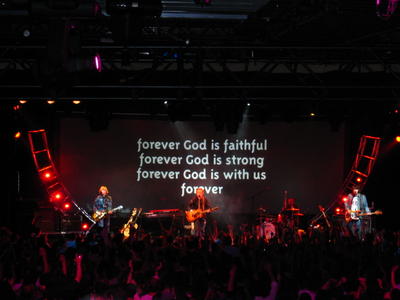
At first I was uncertain about whether to go for the concert but in the end I was so very glad that I went. Chris Tomlin's music turned out to be much better than I expected (he sang lots of stuff from his new album, Arriving) and Matt Redman, whose music I've always liked (Blessed Be Your Name is one of my favourite songs, ever), got quite a bit of stage time too. In a way, the concert was like a big flashy church service, with really cool graphics and fantastic sound and lighting effects. But the best part was that the concert wasn't about any of that or either of them and their status as music stars. The words of the songs came up on screen and everyone sang along. We were all singing to an audience of one. I think it's so human to want to sing when you're happy. When your soul is full of joy, when your feet are full of dancing, and your heart is full of song. I sing because I'm happy, I sing because I'm free, His eye is on the sparrow, and He watches over me.


Indescribable
by Chris Tomlin

From the highest of heights to the depths of the sea
Creation's revealing Your majesty
From the colors of fall to the fragrance of spring
Every creature unique in the song that it sings
All exclaiming

Indescribable, uncontainable,
You placed the stars in the sky
and You know them by name

You are amazing God

All powerful, untameable,
Awestruck we fall to our knees as we humbly proclaim
You are amazing God

Who has told every lightning bolt where it should go
Or seen heavenly storehouses laden with snow
Who imagined the sun and gives source to its light
Yet conceals it to bring us the coolness of night
None can fathom

Indescribable, uncontainable,
You placed the stars in the sky and You know them by name
You are amazing God

Incomparable, unchangeable
You see the depths of my heart
and You love me the same

You are amazing God
You are amazing God

"He determines the number of the stars and calls them each by name."
Psalm 147:4

"When I consider your heavens, the work of your fingers, the moon and the stars, which you have set in place, what is man that you are mindful of him, the son of man that you care for him?"
Psalm 8:2-4

Monday, October 03, 2005

PureLife


Over the weekend Cassandra and I went to the PureLife women's conference organised by her church. This was the first women's conference that I'd ever been to and I was ever so glad that I went. (Thanks Cass! ;)

And this is where words somewhat fail me.

Cassandra's (Oct 3, 4) written a far better account. I highly reccommend it, and I agree with her wholeheartedly.

I learnt more of what it was to love God with all your mind and all your heart.

And I learnt more of what it meant to be loved.

Unconditionally and unfailingly.


Love is patient, love is kind.
It does not envy, it does not boast, it is not proud.
It is not rude, it is not self-seeking,
it is not easily angered, it keeps no record of wrongs.
Love does not delight in evil but rejoices with the truth.
It always protects, always trusts, always hopes, always perseveres.

Love never fails.

1 Corinthians 13:4-8

Friday, September 23, 2005

The Beautiful Letdown

We went to really nice French restaurant in Times Square for dinner with a representative from our sponsorship board.

Chez Josephine is run by Jean-Claude Baker, French adopted son of African-American Josephine Baker - "the most successful music hall performer ever to take the stage" (according to Ebony magazine). She was the toast of Paris in the 1920s, star of stage and screen in the 1930s, Red Cross volunteer and undercover agent in World War II, participant in the 1963 Civil Rights Movement march on Washington, and star of several farewell (and comeback) tours. She also adopted 12 children of different races and called them her "rainbow tribe." The restaurant is named for her and is essentially a celebration of her.

Mr Baker sat and chatted with us for a bit after our meal, regaling us with interesting little restaurant anecdotes and stories of his adoptive mother. He told us also about how he had set up a foundation to celebrate the work of early 20th Century black artists, in honour of his mother. I was most impressed.

The food was superb and the company delightful. The ambience was lovely, with live piano music in tinkling softly in the background. We even got complementary sorbet at the end (our fourth course!) and it was the best sorbet that I had ever had. Seriously. But then again, my experience of sorbet is hardly exhaustive.

We walked to the 42nd Street metro stop to catch the subway home, happily full of sumptious food.

It was close to midnight.

I saw this black girl in the near-empty station, busking for a dime.


She was playing "If I were a rich man" from Fiddler on the Roof, and the painful irony could not be more obvious.

And so this is New York.

An uneasy mix of extremes, an irresolvable tension, a conflicted existence. There is so much beauty and so much pain, all of it side by side.

To borrow words of Switchfoot, this is the beautiful letdown.

This is life.

But thank God that this is not all that there is to it.

Sunday, September 18, 2005

A Trip to the Opera

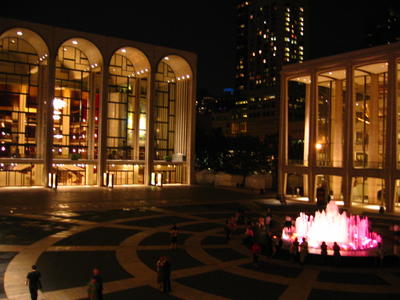
Lincoln Centre


We went to the opera, l'amie and I. Mon amie (see? I learnt a new permutation! :) geniusly found us $16 student rush tickets, and the seats were decent too.

In Madame Butterfly, east meets west. A callous American lieutenant marries a young Japanese girl (Butterfly), only to leave her. He comes back three years later with his American wife, only to find that he has a child. Madame Butterfly loves him desperately and has been waiting for him all this while. She is shattered when she realises that he has abandoned her. He feels deep remorse but it is now too late. He wishes to take the child back to America to give him a better life. She agrees to let to child go with him. When he comes for the child, she commits ritual suicide.


SHE sat quite still, and waited till night fell. She had a sword in her lap.

Butterfly [softly reading the words inscribed on it]
Death with honour is better than life with dishonour.

[points the knife sideways at her throat]

[The door on the left opens, showing Suzuki's arm pushing the child towards his mother: he runs in with outstretched hands. Butterfly lets the dagger fall, darts toward the baby, and hugs and kisses him almost to suffocation.]

Butterfly
You? you?
Beloved Idol!
Ador'd, adorèd being,
Fairest flower of beauty.
[taking the child's head in her hands, she draws it to her]
Though you ne'er must know it
Tis for you, my love, for you I'm dying, Poor Butterfly
That you may go away
Beyond the ocean,
Never to feel the torment when you are older,
That your mother forsook you!

[exaltedly] My son, sent to me from Heaven,
Straight from the throne of glory,
Take one last and careful look
At your poor mother's face!
That it's memory may linger
One last look!
Farewell, beloved!
Farewell, my dearest heart!


I could feel tears welling up in my eyes. It reminded me also of the ending of Miss Saigon (my favourite musical ever), where the sacrifice of the Vietnamese mother is clearer - her erstwhile lover proposes to support her and the child financially in Vietnam, but she kills herself so that he and his wife have no choice but to take the child back to America, where he will have a better life.

For there is no love greater than this - giving yourself up for another, dying so that those you love, may live.

God is love. - 1 John 4:16

Monday, September 12, 2005

The Light in the Darkness

We went on a very enjoyable sunset cruise organised by the university to celebrate the end of the orientation period and the end of the first week of classes. The views from the boat were spectacular. We saw the skyline illuminated in the orange glow of the setting sun, the sky gradually darkening and the city lighting up. It being the day that it is, the twin beams from Ground Zero lit up the sky, reaching so high that they grazed the stars. It was both beautiful and eerie; beautiful for what it was, but eerie for what it represented.

So much of what is beautiful is also oftentimes so very sad. We live in this strange dichotomy, this irreconciliable duality, where the human heart is capable of great love as well as immense cruelty.

You see, I don't think that there's a "them" and an "us". I think there's a "we", and we're all broken, and in our brokenness, we break each other.

Yet we were meant to live for so much more. He who made the sun and the stars, he who breathed blue into the sky and ignited the sunset, formed our hearts, and therein lies the beauty, for we were made in his image. But we have all rejected our first love, turning away from he who made us, and we live lives with no reference to the giver and sustainer of all life. We all go our own selfish way, and this is how we break.

But there is a light in the darkness for we were not, and we are not, left alone.

The opposite of love isn't hate - it's apathy. And he who made us loved us enough to come down to earth to be amidst us, to seek and to save, to mend and to make new, to bring beauty out of brokenness, to turn darkness into light.


Saturday, September 10, 2005

A Timely Mistake

Because I am such a muppet I left my much beloved sunglasses at Abercrombie & Fitch in Staten Island (of all places). Now I have nothing against Staten Island, it's just that it is so far away. But I had to get my sunglasses back. So I went, thinking that this was just going to be another wasted afternoon.

And yet God brings good even out of my careless stupidity, and I pick up a free book at the Activities' Fair from the nice people from Intervarsity Christian Fellowship (thanks guys!) - "Blue Like Jazz" by Donald Miller, "Non religious thoughts on Christian Spirituality" it says on the front. It's a great title. It's also a great book. I highly recommend it.

I read it on the Metro, on the ferry, on the bus, at the food court in Staten Island Mall, and then on the way back.

It was exactly what I needed.

It's just so amazing how God never lets us go.


"In America, the first generation out of slavery invented jazz music. It is a free-form expression. It comes from the soul, and it is true."


"I was watching BET one night, and they were interviewing a man about jazz music. He said jazz music was invented by the first generation out of slavery. I thought that was beautiful because, while it is music, it is very hard to put on paper; it is so much more a language of the soul. It is as if the soul is saying something, something about freedom.


I think Christian spirituality is like jazz music. I think loving Jesus is something you feel. I think it is something very difficult to get on paper. But it is no less real, no less meaningful, no less beautiful.

The first generation out of slavery invented jazz music. It is a music birthed out of freedom. And that is the closest thing I know to Christian spirituality. A music birthed out of freedom. Everybody sings their song the way they feel it, everybody closes their eyes and lifts up their hands."


- Donald Miller, "Blue Like Jazz"